

MVP
You’ve Launched Your MVP. What Comes Next?
Launching your MVP is just the beginning. Learn how to gather user feedback, measure product value, prioritise improvements, manage technical debt, and plan your next stage of growth.
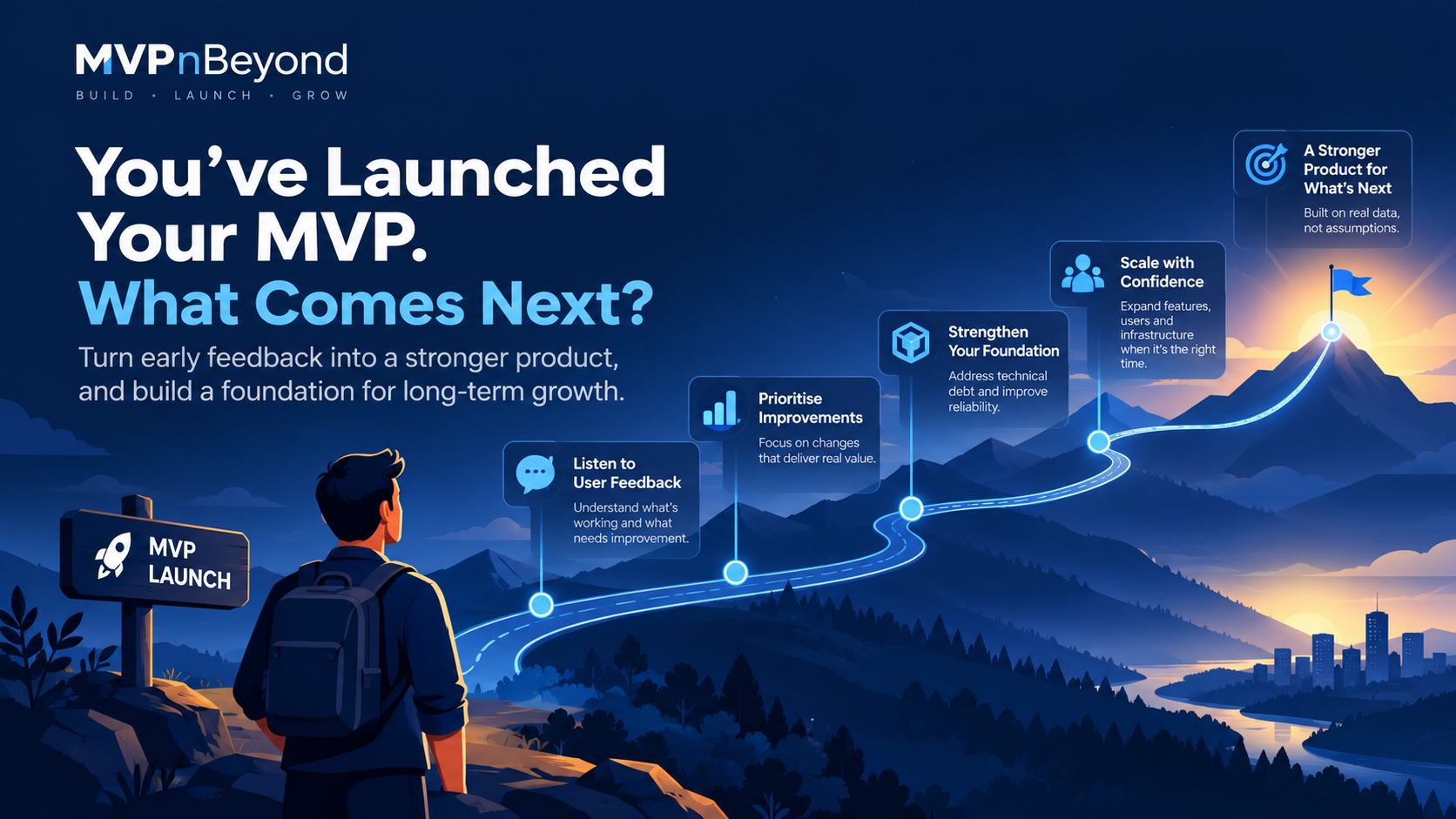
Getting your Minimum Viable Product (MVP) launched is a significant milestone. You’ve taken an idea, turned it into a working product, and made it available to users.
But what happens next?
For many founders, the period after launch can be surprisingly challenging. There’s pressure to add more features, attract more users, fix issues, and demonstrate progress. At the same time, you may still be figuring out whether people truly need the product, which parts they value most, and what deserves your attention next.
The temptation is to move straight into building the next set of features. But a successful product doesn’t grow simply by adding functionality. It grows by responding to what users need, solving problems effectively, and making deliberate decisions about where to invest time and resources.
Your first release gives you something valuable: an opportunity to learn from real-world use. Here’s how to make the most of it.
1. Look Beyond the Launch
A product launch can feel like the finish line, particularly after months of planning and development. In reality, it’s the beginning of a new phase.
Before launch, many product decisions are based on assumptions. You have an idea of who your users are, what they need, and how they will interact with the product. Once people start using it, you can begin comparing those assumptions with actual behaviour.
You may discover that users rely heavily on one feature but rarely use another. A workflow you expected to be straightforward might cause confusion. Or users may ask for something you hadn’t considered because their needs differ from your original expectations.
These discoveries aren’t necessarily signs that the original plan was wrong. They’re part of developing a product that fits its market.
What to do next
Set aside time after launch to review how the product is being used, identify early problems, and collect feedback. Resist the urge to make every change immediately.
First, understand what is happening. Then decide which findings deserve action.
2. Collect Feedback from the Right Users
User feedback is one of the most valuable inputs you can gather after launching an MVP. However, simply asking whether people like your product may not tell you very much.
People may be encouraging without becoming regular users. They may suggest features that sound useful but aren’t important enough to change their behaviour.
Try to understand what users are actually trying to accomplish.
Ask questions such as:
- What were you hoping to achieve when you first used the product?
- Which part of the experience was most useful?
- Where did you get stuck or feel uncertain?
- What are you still doing outside the product to complete the same task?
- What would make you use it more regularly?
Where possible, observe users completing real tasks rather than relying entirely on their descriptions.
For a business application, you might discover that the main workflow works well but users still export data to spreadsheets because a particular report is missing. For a consumer app, you might find that users complete onboarding but don’t return because the ongoing value isn’t clear.
These observations are more actionable than a general request for more features.
Keep the feedback loop small and consistent. Speak with early users, review the issues they report, look for recurring patterns, and follow up after making improvements.
3. Measure Whether the Product Is Delivering Value
Feedback explains what users think and experience. Product data helps you understand what they actually do.
The right metrics depend on your product and business model. A consumer application, a subscription SaaS platform, and an internal business system should not necessarily be measured in the same way.
For example:
For a consumer app, you might monitor onboarding completion, repeat usage, and the percentage of users who return after their first session.
For a SaaS platform, you might track account activation, usage of core workflows, customer retention, and conversion to paid plans.
For an internal business application, you might measure task completion time, adoption across teams, reduction in manual work, and the frequency of errors in the previous process.
You don’t need a complicated analytics setup to begin learning. Start with a small number of measures that reflect the product’s intended value.
If your application is designed to save businesses time, measuring whether users actually complete the relevant task more efficiently may be more useful than counting page views.
Also, avoid interpreting metrics in isolation. A high number of registrations doesn’t necessarily mean users are receiving value, and a feature with relatively low usage may still be important for a specific group.
The objective is to understand whether the product is solving the problem it was designed to address.
4. Prioritise Improvements Instead of Adding Every Requested Feature
Once feedback starts arriving, you’ll probably have more ideas than you can implement at once.
Some users will request new functionality. Others will report bugs or ask for improvements to existing workflows. Your own team may identify performance issues, usability problems, or opportunities to simplify the application.
Without a clear prioritisation process, the product roadmap can quickly become a list of competing requests.
A useful starting point is to group potential work into four categories:
- Critical issues: Bugs, security concerns, or failures that prevent essential workflows from working properly.
- Usability improvements: Changes that help users complete existing tasks more easily.
- Validated feature needs: New capabilities supported by recurring feedback or clear business requirements.
- Future opportunities: Ideas worth exploring but not yet supported by sufficient evidence.
Then evaluate each item based on user impact, business value, implementation effort, and risk.
For example, if several users abandon a workflow because an important step is confusing, improving that workflow may create more value than adding an advanced reporting module that only a few users have requested.
A feature request is useful evidence, but it isn’t automatically a development priority.
The goal is to improve the product’s value, not simply increase its feature count.
5. Fix the Friction Before Expanding the Product
After launch, it’s easy to focus on visible additions: new screens, integrations, dashboards, and capabilities.
But sometimes the best next investment is improving what already exists.
Consider a project-management SaaS product. The team might be planning advanced reporting and AI-powered summaries, while users are struggling with project setup or finding it difficult to invite colleagues.
Adding more functionality won’t necessarily solve those problems. Improving onboarding and simplifying the core workflow may have a greater effect on adoption.
Review the product’s main user journey and look for friction:
- Are users able to get started without unnecessary steps?
- Is the next action obvious?
- Are error messages understandable?
- Does the product behave consistently across devices?
- Are users repeating work that could be simplified?
- Do important workflows perform reliably?
Small improvements can have a meaningful effect when they address problems users encounter frequently.
Before expanding the product, make sure its existing capabilities deliver the value you intended.
6. Address Technical Debt Without Overengineering
An MVP is often built under time and budget constraints. That’s reasonable, provided the team understands which compromises are acceptable and which could create problems later.
After launch, you may discover areas where the implementation needs improvement. Perhaps a feature is difficult to maintain, a database query becomes slow as data grows, or duplicated logic makes changes riskier than expected.
These are opportunities to review technical debt: the future cost created by earlier technical shortcuts or decisions.
Not every shortcut needs immediate attention. Some may have little practical impact, while others could affect reliability, security, delivery speed, or the cost of adding new features.
A sensible approach is to assess technical issues based on their consequences.
Prioritise work that:
- Creates a security or data-integrity risk.
- Causes recurring bugs or unreliable behaviour.
- Makes important changes unnecessarily expensive.
- Limits performance at the product’s current or reasonably expected usage.
- Blocks a validated business requirement.
Avoid rewriting working components simply because a newer framework or architecture is available. Technical improvements should solve a real problem or create a clear advantage.
The objective is to keep the product maintainable and dependable while continuing to deliver business value.
7. Know When to Scale—and When Not To
As usage grows, new requirements may emerge. You may need to support more users, handle larger volumes of data, introduce additional integrations, or improve system performance.
But scaling doesn’t always mean moving to a more complex architecture or investing in infrastructure before it’s needed.
For some products, the next step might be improving a few inefficient database queries. For others, it may involve introducing background processing, optimising API calls, improving monitoring, or revisiting how workloads are handled.
The right response depends on the actual bottleneck.
Look at evidence such as response times, error rates, resource utilisation, database performance, and user reports. Use those findings to identify where improvement is needed.
There are also business questions to consider:
- Is usage growing consistently or only temporarily?
- Which features are driving adoption?
- Are customers willing to pay for the product?
- Can the current operating model support additional customers?
- Which technical limitations are genuinely blocking growth?
A product can have a well-designed technical foundation and still struggle because it hasn’t found a sustainable market. Likewise, a product with growing demand may need targeted technical improvements before it can support more users reliably.
Scale in response to real needs, not hypothetical future demand.
8. Build a Continuous Improvement Cycle
Product development after launch works best as an ongoing cycle rather than a series of disconnected feature releases.
A simple process can help your team stay focused:
Observe → Understand → Prioritise → Build → Measure → Repeat
Start by observing how people use the product and where they encounter problems. Understand the underlying causes rather than responding to every symptom. Prioritise the changes with the clearest value, implement them, and measure the outcome.
Then repeat the process.
For a small team, this doesn’t need to involve elaborate ceremonies or lengthy reports. A regular review of user feedback, product metrics, open issues, and upcoming priorities may be enough to make better decisions.
The important thing is to keep development connected to evidence.
Over time, this process helps you distinguish between improvements that genuinely move the product forward and work that consumes resources without producing meaningful value.
What Should Your Next 90 Days Look Like?
There is no universal post-launch roadmap, but a simple 90-day plan can provide a useful starting point.
Days 1–30: Understand the current product
Focus on stabilising essential workflows, speaking with early users, reviewing product usage, and identifying the biggest points of friction.
Avoid committing to a large set of new features before understanding what the early evidence tells you.
Days 31–60: Improve what matters most
Prioritise a manageable set of improvements based on user impact, business value, and technical risk.
This may include fixing important issues, simplifying onboarding, improving an existing workflow, or implementing a feature that has been validated by user feedback.
Days 61–90: Evaluate and plan the next stage
Review the effect of the changes. Look at whether users are receiving more value, whether adoption or retention is improving, and whether the product is moving toward its business goals.
Use those findings to decide what deserves investment next.
You may identify a clear opportunity for growth. You may discover that the product needs more validation before expanding. Or you may find that improving the current experience is still the highest-value work.
All three outcomes can inform a better product roadmap.
Moving Beyond the MVP
Launching an MVP gives you a starting point, not a guarantee of success. The next stage is about learning what works, addressing what doesn’t, and investing in improvements that make the product more useful and sustainable.
That means listening to users, measuring outcomes, prioritising carefully, maintaining a sound technical foundation, and scaling when the evidence supports it.
You don’t need to build every requested feature or prepare for every possible future scenario. You need to make informed decisions about what the product needs next.
The best next step after an MVP isn’t necessarily a bigger product. It’s a better-informed one.
Need help taking your product beyond the MVP?
At MVPnBeyond, we work with founders and growing businesses to develop, improve, and scale web and mobile products. Whether you’re refining an initial release, planning the next set of features, or addressing technical challenges as usage grows, we focus on practical decisions that support your product’s longer-term goals.
Get in touch with MVPnBeyond to discuss what comes next for your product.



GOT AN IDEA TO DISCUSS?
Let’s build something meaningful.
Whether you’re launching an MVP, scaling an existing platform, or exploring AI-powered opportunities, we’d love to hear about your vision.
No obligation. Usually respond within 1 business day.