
BUSINESS
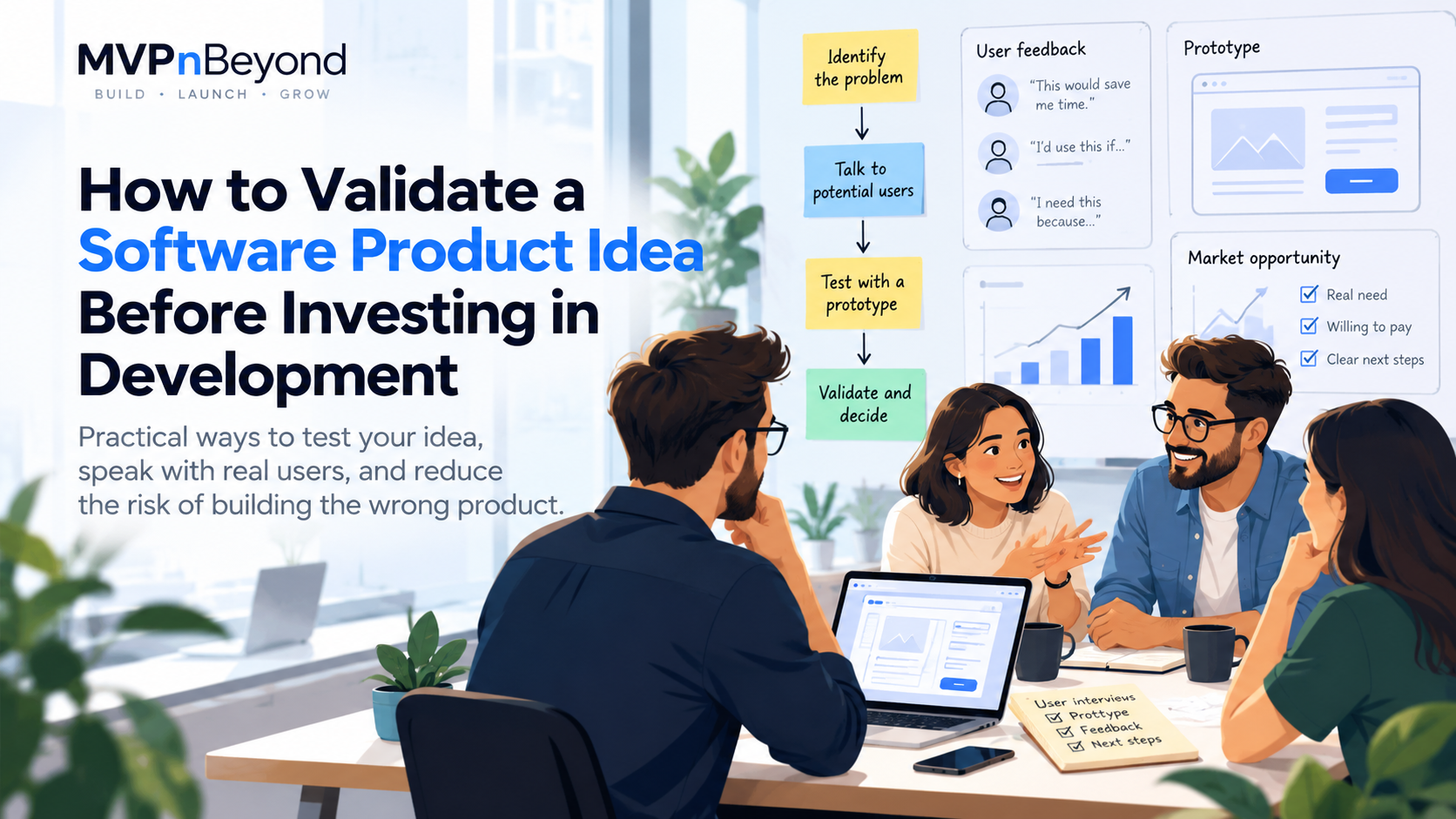
How to Validate a Software Product Idea Before Investing in Development
Before investing in software development, learn how to validate your product idea through customer interviews, competitor research, prototypes, and early demand testing. Reduce uncertainty and make more informed decisions about what to build.
Having an idea for a software product is exciting. You can imagine the features, picture how people will use it, and see the potential for turning it into a business.
But an idea that sounds promising isn’t necessarily a product people need, will use, or are willing to pay for.
Building software takes time, money, and ongoing effort. If you begin development based only on assumptions, you risk investing in features that don’t solve the right problem—or building something for which there isn’t enough demand.
The good news is that you don’t need a fully developed application to start testing your idea.
Product validation helps you gather evidence, challenge assumptions, and make better decisions before committing to a significant development investment.
Here are seven practical steps to help you evaluate a software product idea before you build it.
1. Define the Problem Before Defining the Product
A common starting point is to think about the solution: an app, a SaaS platform, a marketplace, or a new digital service.
But before deciding what to build, get specific about the problem you’re trying to solve.
Who experiences this problem? How often does it occur? What makes it frustrating, expensive, time-consuming, or difficult to manage? What do people currently do to work around it?
For example, suppose you’re considering a platform that helps small businesses manage customer enquiries. The initial idea might include a dashboard, automated follow-ups, analytics, messaging, and AI-powered recommendations.
But the underlying problem might be much simpler: business owners are losing potential customers because enquiries arrive through multiple channels and are easily missed.
That distinction matters. The first version may need to centralise enquiries and help users track follow-ups. The other features might be useful later, but they aren’t necessarily required to test the core idea.
What to do instead
Write a simple problem statement:
- Target user: Who experiences the problem?
- Problem: What are they struggling with?
- Current alternative: How do they handle it today?
- Desired outcome: What would a better solution help them achieve?
If you can’t explain the problem clearly without describing a long list of features, spend more time understanding the problem before planning the solution.
2. Identify Your Initial Target Audience
A product idea can appear relevant to many different people. However, trying to validate it with everyone at once can produce vague or contradictory feedback.
A stronger starting point is to identify a specific group that experiences the problem frequently enough to care about solving it.
For example, a scheduling product might eventually serve freelancers, healthcare providers, consultants, and larger organisations. But each group has different workflows, constraints, and expectations.
You could begin by focusing on independent consultants who coordinate appointments with multiple clients. That gives you a more specific audience to investigate and a clearer way to assess whether the proposed solution is useful.
Consider:
- Who experiences this problem most frequently?
- Who is most affected by it?
- Who currently spends time or money addressing it?
- Who can you realistically reach for interviews or early testing?
- Who would make the decision to adopt or purchase the product?
You don’t need to define your entire future market at this stage. You need a sufficiently clear initial audience to test your assumptions.
3. Speak to Potential Customers Before Building
One of the simplest and most valuable validation activities is talking to people who fit your target audience.
The purpose isn’t to convince them that your idea is good. It’s to understand their existing behaviour and determine whether the problem is significant enough to warrant a solution.
Ask about their experiences rather than presenting your proposed product immediately.
Useful questions include:
- How do you currently handle this task?
- What is the most frustrating part of the process?
- How often does the problem occur?
- What happens when something goes wrong?
- Have you tried any tools or alternatives to address it?
- What do you like or dislike about the solutions you’ve tried?
Suppose you’re considering a platform that automates a manual business workflow. During interviews, you might discover that the process is inconvenient but happens only once a month. Alternatively, you might find that it consumes several hours every week and causes recurring errors.
Those findings can significantly change how attractive the opportunity appears.
Be careful with questions such as, “Would you use an app that does this?” People may say yes because the concept sounds interesting, without having any intention of changing their behaviour.
Past behaviour is usually more informative than hypothetical enthusiasm. Look for evidence of existing workarounds, repeated frustration, time spent, money spent, and willingness to try something different.
4. Research Existing Solutions and Competitors
Finding similar products in the market doesn’t automatically mean your idea is bad. In many cases, it confirms that other people recognise the problem.
The important question is whether you can identify a meaningful opportunity.
Research direct competitors, alternative tools, manual processes, and even spreadsheets that people use to manage the same problem.
For each alternative, consider:
- Who is it designed for?
- Which problem does it solve particularly well?
- Where do users experience limitations?
- What does it cost?
- What do customers consistently praise or complain about?
- Is there a specific audience or workflow that remains underserved?
For example, an existing project-management platform may offer extensive features but feel unnecessarily complicated for a small specialist team. Your opportunity might be a simpler workflow designed around that team’s needs—not an attempt to recreate every feature of the established platform.
Avoid assuming that a competitor’s existence proves demand for your exact solution. Equally, avoid assuming that a market without obvious competitors is automatically an opportunity; it may indicate that the problem is difficult to solve or that demand is limited.
Look for a credible reason why your intended users would choose your approach over what they already do.
5. Test the Idea with a Prototype or Simple Demonstration
Once you understand the problem and have an initial hypothesis about the solution, create something people can react to.
That doesn’t necessarily mean building a functional application.
Depending on the idea, you could use:
- Wireframes: Simple screen layouts that communicate the proposed workflow.
- Clickable prototypes: Interactive designs that let users experience the main journey.
- Landing pages: A concise explanation of the proposed product with a way for interested users to register or request access.
- Demonstrations: A walkthrough showing how the product would solve a specific problem.
- Manual pilots: Delivering the intended outcome with some tasks handled manually before automating them.
For example, if you’re considering a booking platform, a clickable prototype could demonstrate how a customer selects a service, chooses an available slot, and receives confirmation.
You can then observe whether prospective users understand the flow, what questions they ask, and which parts of the experience create confusion.
A prototype helps validate usability and understanding. It does not, by itself, prove that users will pay for the product or that the underlying technology will work at scale.
Choose the simplest test that can answer the question you’re trying to resolve.
6. Test Willingness to Pay and the Business Model
A product can solve a genuine problem and still struggle as a business.
People might appreciate a solution without being willing to pay for it. The person who experiences the problem may not control the budget, or the cost of acquiring and supporting customers may make the business model difficult to sustain.
If your product is intended to generate revenue, start exploring how it might do so before committing to a large development effort.
Consider:
- Who would pay for the product?
- What would they be paying to achieve?
- Would the model be subscription-based, usage-based, transaction-based, or something else?
- What alternatives are customers paying for today?
- What level of pricing seems reasonable relative to the value delivered?
- How will you reach potential customers?
Where appropriate, move beyond asking whether someone would pay. Test their willingness to take a concrete next step.
Depending on the business and what you can genuinely offer, this could mean requesting a pilot, joining a qualified early-access programme, agreeing to a discovery session, or discussing a paid trial.
Be transparent about what exists and what is still being developed. Don’t present a concept as a finished product or take payment for something you cannot deliver.
For business-to-business products, conversations with actual budget holders can be especially useful. A person who likes the idea may not be the person responsible for purchasing software.
7. Define What Evidence You Need Before Moving Forward
Validation isn’t a single activity that produces a definitive yes-or-no answer. It is a process of reducing uncertainty.
Before conducting interviews or testing a prototype, decide what you want to learn and what evidence would influence your next decision.
For example, you might want to establish whether:
- The problem occurs frequently enough to matter.
- Your target audience is already spending time or money addressing it.
- Users can understand and complete the proposed workflow.
- Potential customers are willing to participate in a pilot.
- The proposed pricing and business model are plausible.
- The product can be delivered within a realistic budget and timeframe.
You don’t need arbitrary targets that apply to every product. The evidence required will depend on the market, the cost of development, the risk involved, and the nature of the business.
After gathering feedback, look for patterns rather than relying on a single enthusiastic response.
If the problem is real but users don’t understand your proposed solution, you may need to revise the concept. If the workflow is appealing but nobody is willing to commit to a pilot, investigate the value proposition, target audience, or purchasing process.
If the evidence is encouraging, you can move toward defining a focused MVP. If it isn’t, changing the idea—or deciding not to proceed—may be the better investment decision.
The purpose of validation is not to justify building what you originally imagined. It’s to discover what is worth building.
From Validation to an MVP
Once you have enough evidence to justify moving forward, the next step is to translate what you’ve learned into a practical first release.
This means defining the essential user journey, prioritising features, identifying technical requirements, estimating the effort involved, and deciding what can safely wait.
A useful progression is:
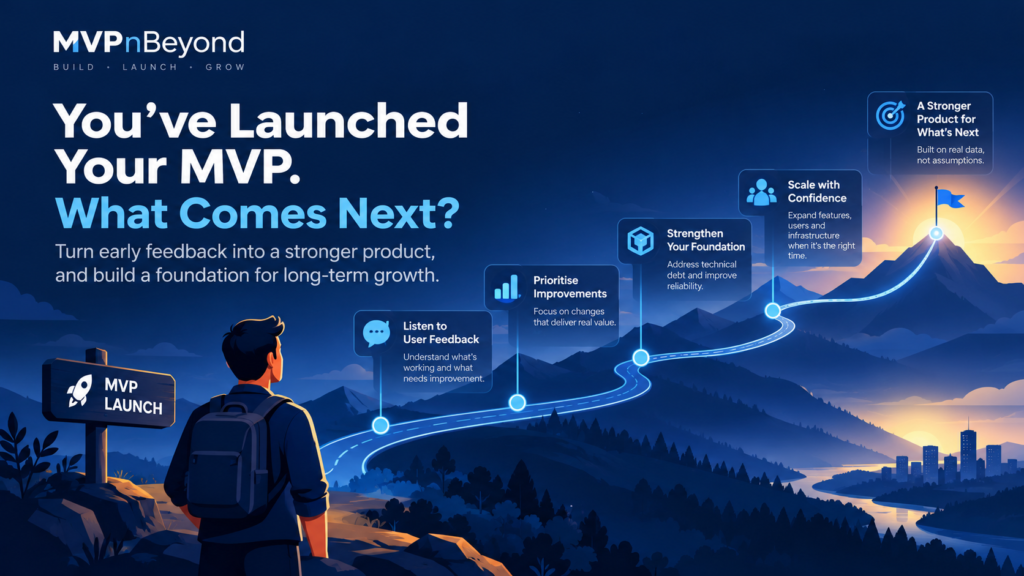
Problem → Research → Prototype → Validation → MVP → Feedback → Improvement
Each stage answers a different question.
Research helps you understand the problem. Prototyping helps you explore the experience. Validation provides evidence about demand and usability. The MVP delivers the core solution to real users, allowing you to learn from actual use.
Not every product needs the same sequence or the same amount of work at each stage. A relatively simple product idea may need only focused interviews and a prototype, while a complex or highly regulated product may require more extensive research, risk assessment, and technical planning.
The key is to avoid treating development as the first and only way to learn.
A Practical Checklist Before Investing in Development
Before committing to a significant build, ask yourself:
- Can I clearly explain the problem and who experiences it?
- Have I spoken with people who fit my target audience?
- Do I understand how they currently solve the problem?
- Have I investigated existing alternatives and competitors?
- Have I tested the proposed workflow or experience in a low-cost way?
- Do I have evidence that users will adopt the solution—or pay for it, if that is the business model?
- Can I define a focused MVP with a realistic scope and budget?
- Do I know what I still need to learn?
You don’t need every uncertainty resolved. That is rarely possible at the beginning of a product journey.
You do need to understand the biggest risks and make a deliberate decision about whether the evidence justifies the next investment.
Validate First. Build with Greater Confidence.
A promising software product doesn’t begin with a long feature list or a detailed technical specification. It begins with a problem worth solving and a willingness to test assumptions before committing significant resources.
By understanding your users, researching alternatives, testing a prototype, and exploring the business model, you can make better decisions about what to build—and what not to build.
Validation doesn’t eliminate risk, and it doesn’t guarantee product-market fit. What it can do is help you avoid preventable mistakes, focus development on the right problem, and enter the build phase with a clearer direction.
You don’t need to build the entire product to find out whether the idea has potential. Start by testing the assumptions that matter most.
Turning your product idea into a practical plan?
At MVPnBeyond, we help founders and growing businesses move from product ideas to well-defined, buildable web and mobile solutions. From early product planning and prototyping to MVP development and ongoing improvements, we focus on helping you make informed decisions about what to build first.
Get in touch with MVPnBeyond to discuss your idea and explore the right next step.

GOT AN IDEA TO DISCUSS?
Let’s build something meaningful.
Whether you’re launching an MVP, scaling an existing platform, or exploring AI-powered opportunities, we’d love to hear about your vision.
No obligation. Usually respond within 1 business day.