AI
How to Choose the Right Technology Stack for Your Startup
Choosing a technology stack is about more than picking popular frameworks. Learn how to evaluate product requirements, development costs, scalability, security, and team expertise to make a practical choice for your startup.
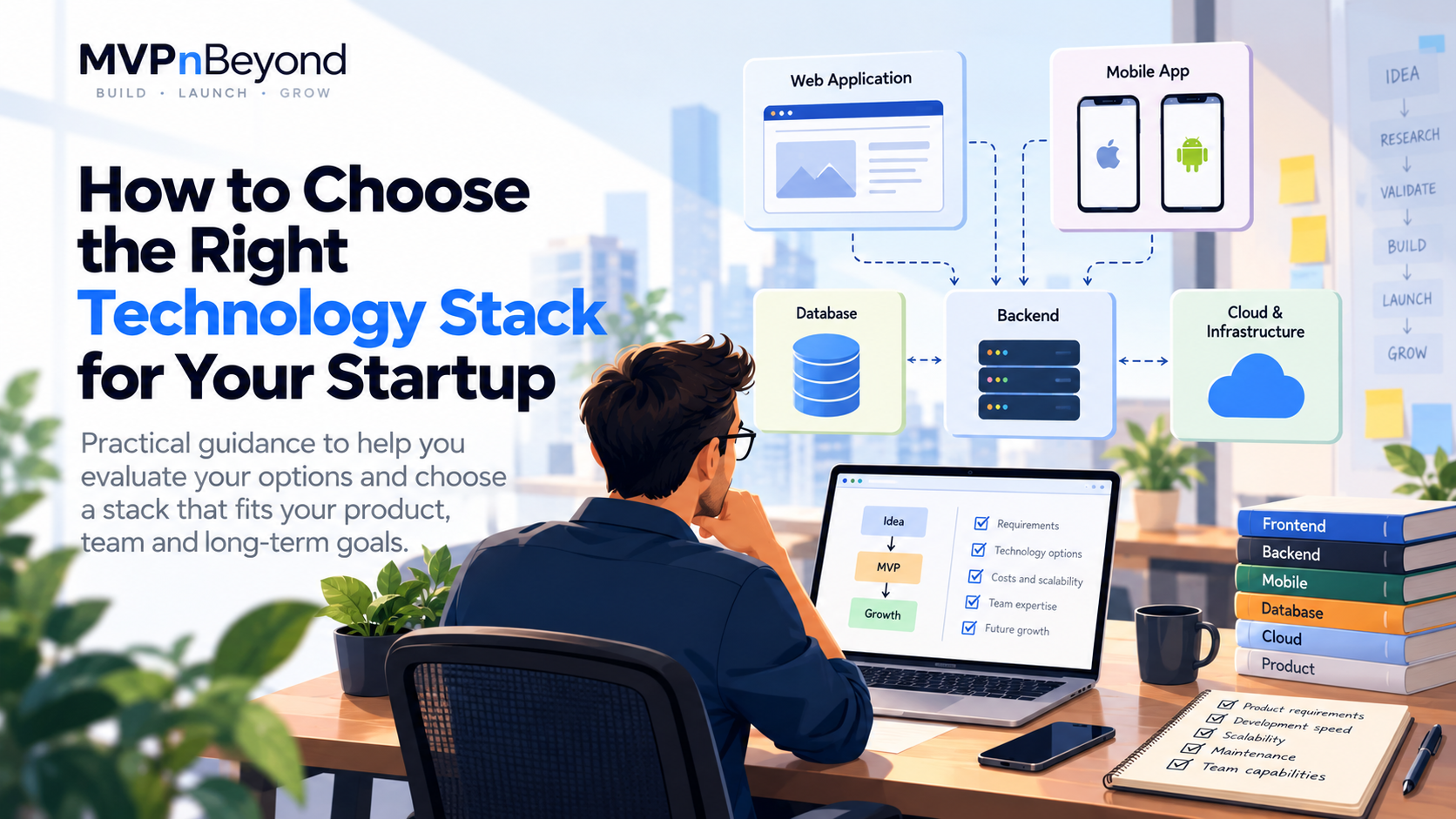
When planning a new software product, one of the first technical questions you’ll encounter is: which technology stack should we use?
You might be considering React or Angular for the frontend, Node.js or Laravel for the backend, Flutter or React Native for a mobile application, and several options for your database and hosting infrastructure.
Each technology has its strengths. But choosing a stack isn’t simply about comparing programming languages or selecting the tools with the most attention in the market.
The decision can influence development speed, initial costs, hiring options, maintenance effort, integrations, and how easily your product can evolve as your business grows.
The right technology stack is the one that fits your product’s requirements, your team’s capabilities, and your realistic plans for the future. It doesn’t need to be the newest or most complex combination of technologies.
Here are seven factors to consider before making that decision.
1. Start with the Product Requirements, Not the Technology
It’s tempting to begin by choosing a familiar framework and then plan the product around it. A better approach is to understand what you’re building first.
A content-focused website, a multi-tenant SaaS platform, a real-time collaboration tool, and a mobile application with offline functionality can have very different technical needs.
For example, a simple business dashboard may work well as a web application. A field-inspection product used in locations with unreliable connectivity may need a mobile application that can store information locally and synchronise it later.
Similarly, a platform that processes large volumes of real-time data may have different infrastructure requirements from an application that primarily manages forms, records, and administrative workflows.
Before comparing technologies, clarify:
- What are the product’s core features and workflows?
- Who will use it, and on which devices?
- Does it need to work offline or support real-time updates?
- Which external systems or services must it integrate with?
- What data will it handle, and what security requirements apply?
- What performance and availability expectations are realistic?
These answers help narrow your options. Without them, technology comparisons can become a discussion about preferences rather than practical needs.
2. Choose the Right Platform: Web, Mobile, or Both?
One of the most consequential early decisions is whether your product should be a web application, a mobile application, or a combination of the two.
Each approach has advantages, and the best option depends on how users need to interact with your product.
When a web application makes sense
A web application can be a strong starting point for business dashboards, SaaS platforms, administration systems, internal tools, and products that users primarily access through a browser.
Users can access it without installing an application, and updates can generally be deployed centrally.
For many business products, a responsive web application can provide the necessary experience across desktop, tablet, and mobile browsers.
When a mobile application makes sense
A dedicated mobile application may be appropriate when the product relies on device capabilities, frequent mobile usage, push notifications, camera access, location services, or offline workflows.
For example, a field-service application used by inspectors, delivery teams, or technicians may benefit from native or cross-platform mobile capabilities.
When both are justified
Some products genuinely need a mobile application and a web-based administration or management platform. Others may benefit from starting with one platform and introducing another after validating demand.
Building for every platform immediately can increase development, testing, and maintenance costs.
Choose platforms based on the user experience and business requirements, not simply because having a website and an app sounds more complete.
3. Evaluate the Main Technology Options
Once you understand the product requirements, you can compare technologies that are suitable for the job.
There is no single stack that is best for every startup. The following examples illustrate common options rather than prescribing a universal solution.
Frontend development
The frontend determines how users interact with the application.
Technologies such as React, Angular, and Vue are commonly used to build web interfaces. Each has a different ecosystem, development approach, and set of trade-offs.
The decision should consider the complexity of the interface, the availability of suitable developers, integration requirements, and the team’s existing experience.
For a relatively straightforward application, the most appropriate option may be the one that enables the team to deliver a reliable experience without unnecessary complexity.
Backend development
The backend handles application logic, data access, authentication, APIs, integrations, and other server-side responsibilities.
Common options include Node.js, Laravel, Django, and other established frameworks and platforms.
The right choice depends on the application’s requirements, the team’s capabilities, available libraries, integration needs, and how the backend is expected to evolve.
For example, a product with extensive API integrations and asynchronous operations may have different considerations from a system centred on structured business workflows and administrative operations.
Mobile development
For mobile products, options include native development using Swift for iOS and Kotlin for Android, as well as cross-platform frameworks such as Flutter and React Native.
Native development can provide direct access to platform-specific capabilities and control over the individual platform experience. Cross-platform approaches can allow teams to share a substantial portion of their code between iOS and Android.
However, cross-platform doesn’t mean that every component can be shared or that platform-specific testing is unnecessary.
Consider the required user experience, device integrations, performance expectations, available skills, and long-term maintenance needs before choosing.
Database and infrastructure
Your database and hosting approach should reflect the data model, access patterns, consistency requirements, security needs, and operational constraints of the product.
Relational databases such as PostgreSQL and MySQL are useful for many applications with structured data and relationships. Other data-storage technologies may suit particular access patterns or data models.
Likewise, cloud platforms can provide flexibility, managed services, and options for scaling, but the most elaborate infrastructure isn’t automatically the best starting point.
Choose the simplest suitable architecture that can meet the product’s current needs and support its foreseeable development.
4. Consider Development Speed, Budget, and Total Cost of Ownership
For an early-stage startup, time and budget are often limited. The technology stack should support efficient delivery without creating avoidable long-term costs.
However, the cheapest initial implementation isn’t necessarily the least expensive option over the product’s lifetime.
A technology that enables rapid development may still require substantial maintenance if it doesn’t fit the team’s skills or the application’s requirements. Conversely, choosing a highly specialised or complex architecture can increase development effort without delivering meaningful benefits at the current stage.
When estimating cost, consider more than the first release:
- Initial implementation and testing.
- Developer availability and hiring costs.
- Third-party services, licences, and hosting.
- Ongoing maintenance and security updates.
- Monitoring, backups, and operational support.
- Future integrations and expected product improvements.
- The cost of changing technologies if the current approach becomes unsuitable.
Existing team expertise matters here. If your team already works effectively with a mature technology stack that meets the requirements, adopting an entirely new stack may introduce learning costs without a clear advantage.
At the same time, familiarity shouldn’t be the only deciding factor if the existing approach cannot meet important product needs.
The goal is to make a cost-effective decision across the product’s lifecycle, not merely minimise the initial development estimate.
5. Plan for Growth Without Overengineering
Every founder hopes their product will grow. But designing for hypothetical future demand can make the first version unnecessarily complicated.
A startup launching an MVP usually doesn’t need the same infrastructure as a platform serving millions of active users. It does, however, need a technical foundation that avoids obvious limitations and allows sensible improvements as the product develops.
A practical approach is to distinguish between requirements you already know and possibilities you may encounter later.
For example, you might need a clear separation between application components, reliable database design, appropriate access controls, and a deployment process that supports safe updates.
You may not need a large microservices architecture, multiple database technologies, or sophisticated orchestration from the beginning.
A well-structured application built as a modular system may be entirely appropriate for an initial release. As the product grows, you can make targeted changes based on actual bottlenecks and evolving requirements.
Scalability is also more than infrastructure. It includes whether the system can be maintained, whether the team can implement changes efficiently, and whether the product can support new workflows without becoming unnecessarily fragile.
Build for the requirements you understand, and make deliberate decisions that leave room for the product to evolve.
6. Think About Security, Reliability, and Maintenance from Day One
Technology decisions affect how easily a product can be secured, maintained, and operated.
An MVP may have a limited feature set, but it still needs appropriate security and reliability for its intended users and data.
Consider how the chosen stack supports:
- Authentication and access control.
- Secure data storage and transmission.
- Input validation and error handling.
- Dependency and security updates.
- Automated testing and deployment.
- Logging, monitoring, and backups.
- Recovery from failures and data loss.
The specific requirements will depend on the product. An application handling sensitive personal information or financial transactions will have different risk considerations from a simple public-facing information site.
You should also consider the maturity of the technology ecosystem. Established frameworks often have documentation, libraries, community knowledge, and available developers that can make ongoing maintenance easier. Newer technologies may offer advantages too, but their suitability should be assessed in context.
A stack that is easy to launch but difficult to maintain can become a costly constraint as the product evolves.
7. Choose Technologies Your Team Can Support
A technology stack is only as useful as your team’s ability to work with it effectively.
A technically promising framework may be a poor choice if experienced developers are difficult to find, the learning curve is significant, or the product will be difficult to support after launch.
This is particularly important for startups working with a small development team or an external development partner.
Ask:
- Does the team have relevant experience with the proposed stack?
- Can the team find reliable documentation and libraries?
- Will it be practical to maintain the application over several years?
- Are there developers available if the team needs to expand?
- Can another developer understand and work with the codebase?
- Does the technology fit the delivery and support model?
The answer doesn’t always need to be the most popular technology. A less fashionable but mature and well-supported stack can be a sensible choice when it fits the product and the team.
Likewise, avoiding every new technology isn’t a strategy in itself. New tools and frameworks are worth evaluating when they provide a clear benefit and can be adopted responsibly.
Focus on the team’s ability to deliver and maintain the product, rather than choosing technologies simply to follow industry trends.
A Practical Framework for Making the Decision
If you’re comparing several possible stacks, use a simple decision process rather than trying to identify a universally superior option.
Step 1: Define the must-haves
List the product’s essential requirements, including platforms, integrations, data handling, performance, security, and any offline or real-time needs.
Step 2: Shortlist suitable options
Identify a small number of technology combinations that can meet those requirements. Eliminate options that introduce unnecessary constraints or complexity.
Step 3: Compare the trade-offs
Evaluate the shortlisted options based on development effort, team expertise, maintainability, ecosystem maturity, operating costs, and the ability to support likely product changes.
Step 4: Validate technical uncertainty
If an important question remains unresolved, build a small proof of concept or test the relevant integration before committing to the full implementation.
For example, you might test whether a required third-party API supports your intended workflow or whether a particular mobile framework can access the necessary device capabilities.
Step 5: Make a decision and document why
Record the main reasons for your choice, the important trade-offs, and any assumptions that may need to be revisited.
This doesn’t need to be a lengthy technical document. A short explanation can help the team make consistent decisions and avoid repeatedly debating the same questions.
Common Technology Stack Mistakes to Avoid
Before finalising your choice, watch out for a few recurring mistakes:
- Choosing based on popularity alone: A trending framework isn’t automatically the right fit.
- Using too many technologies: Every additional tool can introduce integration and maintenance overhead.
- Ignoring team expertise: Learning an entirely new ecosystem can affect timelines and costs.
- Overengineering for hypothetical scale: Complexity should be justified by real requirements or foreseeable risks.
- Ignoring long-term maintenance: Initial development cost is only part of the total investment.
- Choosing before defining the product: The stack should support the requirements, not dictate them unnecessarily.
The aim isn’t to find a perfect technology stack that will never need to change. It’s to make a well-reasoned decision that supports the product today and provides a practical path forward.
Final Thoughts
Choosing the right technology stack is an important decision, but it doesn’t have to become an obstacle to getting your product started.
Begin with the problem, understand the requirements, compare suitable options, and consider both the initial build and the ongoing cost of ownership. Pay attention to your team’s capabilities, and invest in technical experimentation where uncertainty could create significant risk.
You don’t need the most complex architecture or the newest framework to build a successful product. You need technologies that help you deliver the right experience reliably, maintain it effectively, and evolve it as your business learns and grows.
The best technology stack isn’t the one with the most features. It’s the one that helps you build and sustain the product your users actually need.
Planning a new software product?
At MVPnBeyond, we help founders and growing businesses make practical technology decisions and turn product requirements into web applications, mobile apps, and SaaS platforms. We focus on choosing suitable technologies, building a reliable first release, and creating a foundation for future improvements.
Get in touch with MVPnBeyond to discuss your product and the right approach to building it.

GOT AN IDEA TO DISCUSS?
Let’s build something meaningful.
Whether you’re launching an MVP, scaling an existing platform, or exploring AI-powered opportunities, we’d love to hear about your vision.
No obligation. Usually respond within 1 business day.