
AI
From MVP to SaaS: What It Takes to Build a Scalable Software Product
Moving from an MVP to a SaaS platform involves more than adding features. Learn how to approach multi-tenancy, user permissions, billing, security, maintainability, and scaling as your software product grows.
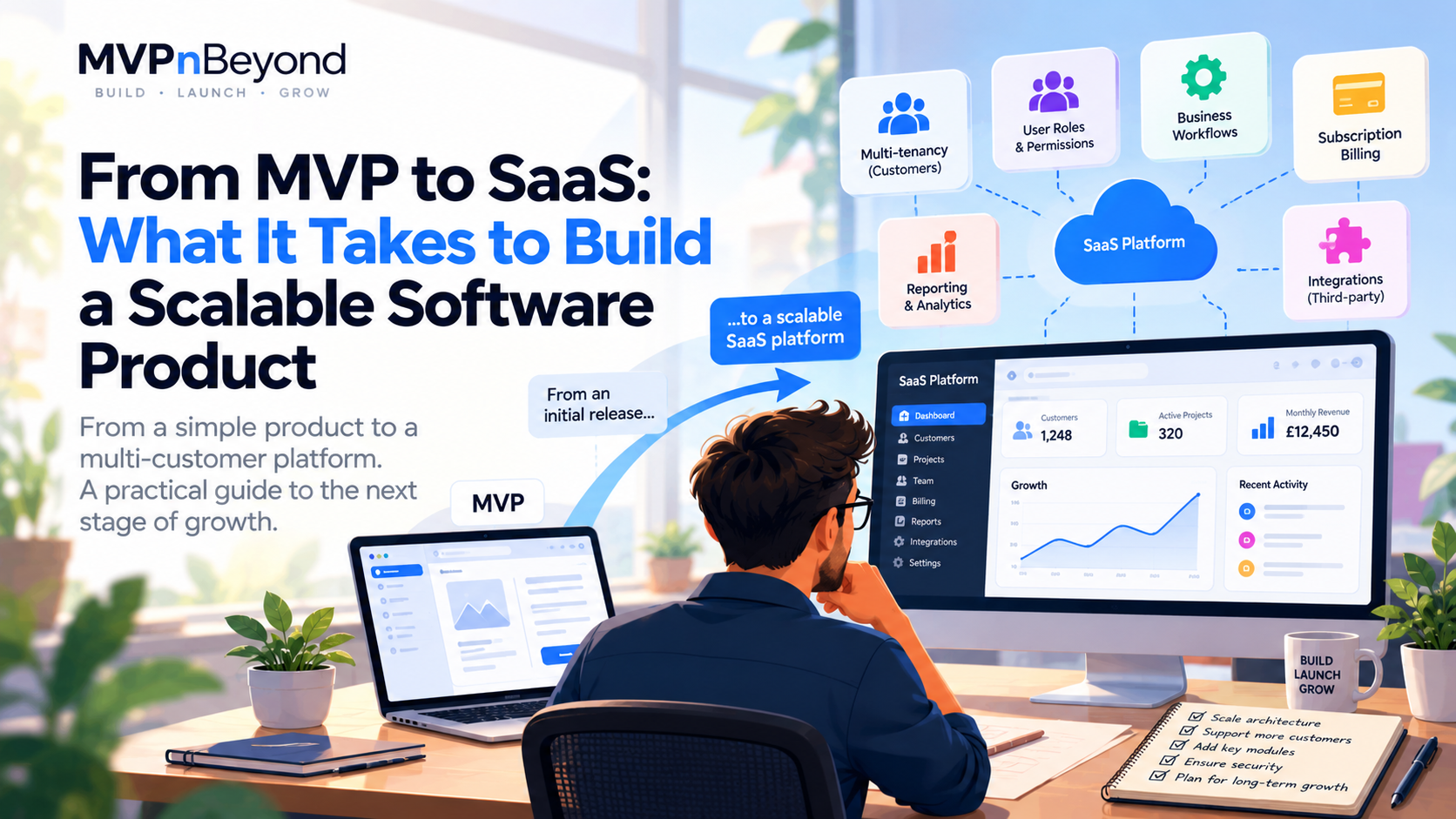
Building a working software product is an important milestone. You’ve taken an idea, developed its core functionality, and created something users can interact with.
But as the product gains traction, new requirements begin to emerge. You may need to support multiple customers, introduce different user roles, manage subscriptions, integrate with other systems, or make the application easier to maintain as it grows.
This is where the journey from an MVP to a more mature Software-as-a-Service (SaaS) product begins.
An MVP helps you validate an idea and deliver its essential value. A SaaS platform must continue delivering that value as customers, data, workflows, and business requirements evolve.
The transition doesn’t require rebuilding everything at once. It requires understanding which foundations are needed now, which capabilities can wait, and how to evolve the product without introducing unnecessary complexity.
Here are seven important considerations when taking a software product from an initial release towards a scalable SaaS platform.
- Understand When Your MVP Needs to Evolve
Not every MVP needs to become a large SaaS platform. Some products remain relatively simple, while others gradually develop into more comprehensive systems.
The important question is whether the current implementation can continue supporting the product’s actual needs.
You may start noticing signs that it’s time to evolve the platform:
- New customers require different workflows or configurations.
- User roles and permissions are becoming more complicated.
- Manual administration is consuming increasing amounts of time.
- The application is becoming harder to maintain as features are added.
- Customers need integrations, reporting, or additional business functionality.
- Performance or reliability problems are affecting the user experience.
For example, an initial business-management application might begin with a dashboard and a few core workflows. As more organisations adopt it, each may need its own users, projects, settings, reporting, and access permissions.
The product is no longer just about implementing the next feature. It also needs a structure that supports multiple customers consistently.
What to do instead
Review the product’s actual usage, customer needs, and technical limitations. Identify which changes are necessary to support the next stage of growth.
Avoid expanding the architecture simply because the product is becoming more successful. Evolve it in response to real requirements.
- Plan for Multiple Customers and Data Isolation
One of the important decisions in a SaaS product is how different customers—or tenants—will share the platform.
A multi-tenant architecture allows multiple organisations to use the same application while keeping their information and access appropriately separated.
For example, a business operations platform might support several consulting companies. Each organisation has its own employees, clients, projects, expenses, and reports, but all use the same underlying product.
The platform needs to ensure that users can access only the information and functions they are authorised to use.
Multi-tenancy affects more than database design. It can influence authentication, authorisation, API behaviour, reporting, file storage, background processing, and administrative tools.
There are different ways to implement it. Some systems use shared database tables with tenant identifiers and carefully enforced access rules. Others use separate schemas or databases, depending on isolation requirements, operational needs, and the nature of the data.
There is no single architecture that suits every SaaS product.
What to do instead
Determine how customers should be separated, what information they can share, and how the system will enforce those boundaries.
Treat data isolation as a foundational requirement, not something to patch in after multiple customers are already using the platform.
- Build the Right User Roles and Permissions
As a product grows, not everyone should have the same level of access.
A simple MVP may begin with one administrator and a small number of users. A more mature SaaS platform may need organisation owners, managers, employees, external clients, and read-only users.
Each role may need different permissions.
Consider a project-management platform:
- An organisation owner may manage subscription settings and users.
- A project manager may create projects, assign tasks, and review reports.
- A team member may update assigned work and record hours.
- A client may view selected project information without accessing internal records.
These distinctions affect how the product behaves across screens, APIs, reports, and administrative workflows.
Simply hiding a button in the interface isn’t sufficient protection. The backend must also verify that the user is permitted to perform the requested action.
What to do instead
Map the important roles and their responsibilities early. Start with the permissions required by the current product, while keeping the implementation flexible enough to accommodate justified future needs.
Avoid building a highly complex permission system before it’s necessary, but don’t treat access control as an afterthought.
- Design for the Workflows Customers Actually Need
A SaaS product becomes more valuable when it supports the workflows customers rely on to get their work done.
As the platform evolves, users may need connected functionality rather than isolated features.
For example, a business operations platform might begin with client management. Over time, customers may need to connect clients with projects, team assignments, work-hour tracking, expense logging, invoicing, and performance reporting.
The challenge is ensuring these modules work together consistently.
Adding each feature independently can create duplicated information, confusing navigation, inconsistent business rules, and unnecessary manual work.
What to do instead
Map the relationships between the main business entities and workflows. Decide how information should move between modules and where shared rules should be applied.
For example, recorded work hours might feed into project reports and invoicing. Changes to a client or project should be reflected consistently wherever that information is used.
This doesn’t mean every module must be built at the same time. It means the product should have a coherent approach to how its essential components interact.
A well-designed SaaS platform should help customers complete their work with fewer disconnected steps, not simply provide a growing list of screens.
- Introduce Subscription Management and Billing Carefully
For subscription-based SaaS products, billing becomes part of the product’s core functionality.
The requirements can extend beyond collecting payments. Depending on the business model, you may need to manage subscription plans, trials, renewals, upgrades, cancellations, failed payments, invoices, and access to paid features.
For example, a platform might offer a basic plan for small teams and a higher tier with additional users, reporting, or integrations.
The system needs to understand which plan an organisation has, which features it can access, and what happens when its subscription changes.
Billing logic also needs to handle less straightforward situations, such as payment failures, plan changes during a billing period, and cancelled subscriptions that remain active until the end of the paid term.
What to do instead
Define the subscription lifecycle and business rules before implementing billing.
Where appropriate, use an established payment provider rather than attempting to build payment processing from scratch. However, remember that integrating a payment gateway does not automatically solve subscription management, entitlement checks, invoicing requirements, or customer support workflows.
Keep payment handling, subscription status, and feature access consistent throughout the application.
Not every MVP needs a full subscription system on day one. If the product’s business model has been validated and recurring billing is necessary, plan the capability as part of the next stage.
- Strengthen Reliability, Security, and Maintainability
As more customers depend on a product, the consequences of failures become more significant.
A bug that affects one early tester may become a serious operational problem when it disrupts several organisations. A slow report may be inconvenient with a small dataset but become difficult to use as data accumulates.
The product’s technical foundation needs to evolve alongside its usage.
Important areas include:
Performance: Monitor actual response times, database queries, and resource usage. Optimise the parts of the system that create measurable bottlenecks.
Security: Review authentication, permissions, data handling, dependencies, and other risks appropriate to the product.
Testing: Protect important business workflows with automated tests and integration testing. Test changes that affect shared functionality carefully.
Monitoring: Establish useful logging, error reporting, and alerts so the team can identify and investigate problems.
Backups and recovery: Make sure important data can be recovered and that the recovery process is understood and tested.
Maintainability: Keep the codebase structured so developers can fix issues and introduce new features without making every change unnecessarily risky.
These capabilities don’t all require enterprise-scale infrastructure. The appropriate approach depends on the product’s complexity, data sensitivity, usage, and business requirements.
The goal is to establish a reliable platform that can be operated and improved with confidence.
- Scale Gradually Instead of Overengineering
The word scalable is often associated with complex architecture, distributed systems, microservices, and extensive cloud infrastructure.
Those approaches can be appropriate for certain products, but they are not requirements for every SaaS platform.
A well-structured application with a suitable database and deployment setup may support the product’s needs for a considerable time.
As usage grows, the team can assess where improvements are necessary. That might involve optimising database queries, introducing background jobs, caching frequently requested data, improving file handling, or separating a particularly demanding component.
The important thing is to understand the actual constraint before choosing the solution.
For example, if a report is slow because of an inefficient database query, introducing a microservices architecture may add complexity without addressing the underlying problem.
Likewise, if a platform handles long-running tasks, background processing may improve the user experience without requiring a complete redesign.
What to do instead
Build a foundation that is maintainable and appropriate for the current product. Monitor how it performs, identify bottlenecks, and introduce complexity only when it provides a clear benefit.
Scaling is an ongoing engineering decision, not a one-time architectural milestone.
A Practical Roadmap from MVP to SaaS
The transition from an initial release to a more mature SaaS product is easier to manage when broken into stages.
Stage 1: Validate the core product
Confirm that the product solves a real problem and that users can complete the essential workflows.
Focus on reliability, usability, and learning from early customers. Avoid building an extensive platform before the core value is established.
Stage 2: Establish the foundations
As the product moves towards serving multiple customers, address the foundations required by the business model.
Depending on the product, this may include tenant isolation, user roles, permissions, data structure, onboarding, and administration.
Not every product requires all of these capabilities immediately. Prioritise the requirements that are necessary for the next stage.
Stage 3: Connect business workflows
Introduce additional modules and integrations where they provide clear value.
Ensure that information flows consistently between the product’s core functions and that users can complete important tasks without unnecessary duplication.
Stage 4: Improve operations and reliability
Strengthen testing, monitoring, security, backups, deployment practices, and support processes as the product’s usage and business importance increase.
Stage 5: Expand based on evidence
Use customer feedback, product usage, operational data, and business priorities to decide what comes next.
This could mean adding subscription tiers, supporting more complex organisations, introducing integrations, or improving performance.
The roadmap should reflect the needs of the product and its customers—not a predetermined checklist of technologies.
Common Mistakes When Evolving a SaaS Product
A few recurring mistakes can make the transition more expensive or complicated than it needs to be:
- Adding features without a coherent structure: New modules become difficult to maintain when their data and workflows are disconnected.
- Treating multi-tenancy as a simple user filter: Customer data isolation must be enforced throughout the system.
- Delaying important security decisions: Access control and data protection become harder to correct when they are deeply embedded in the application.
- Building billing before defining the business rules: Subscription plans, entitlements, renewals, and cancellations need clear behaviour.
- Overengineering for hypothetical growth: Complex infrastructure creates costs and operational responsibilities that may not yet be justified.
- Ignoring maintenance after launch: A product needs ongoing testing, monitoring, updates, and support—not just new functionality.
The common theme is that a SaaS platform needs deliberate product and engineering decisions, but those decisions should be proportionate to its stage and requirements.
Final Thoughts
Moving from an MVP to a SaaS platform is not simply a matter of adding more features. It involves evolving the product’s architecture, workflows, customer management, security, and operational capabilities as the business develops.
Some foundations need to be established early, especially when multiple customers, sensitive data, or complex permissions are involved. Other capabilities can be introduced gradually as demand becomes clearer.
The most effective approach is to understand what the product needs today, anticipate reasonable next steps, and build in a way that makes future improvements manageable.
A scalable SaaS product isn’t built by making everything complex from the beginning. It’s built by making the right decisions at the right time.
Planning to take your product beyond its MVP?
At MVPnBeyond, we build custom software products and SaaS platforms designed around real business workflows. From initial product development to multi-tenant systems, integrations, and ongoing improvements, we help businesses evolve their products with a practical approach to engineering and growth.
Get in touch with MVPnBeyond to discuss your SaaS product and what it needs next.


GOT AN IDEA TO DISCUSS?
Let’s build something meaningful.
Whether you’re launching an MVP, scaling an existing platform, or exploring AI-powered opportunities, we’d love to hear about your vision.
No obligation. Usually respond within 1 business day.