
MVP
What Should an MVP Actually Include? 7 Common Mistakes to Avoid
What should your MVP include—and what can wait? Explore seven common mistakes founders make when defining product scope, from feature overload to overlooking usability, reliability, and validation.
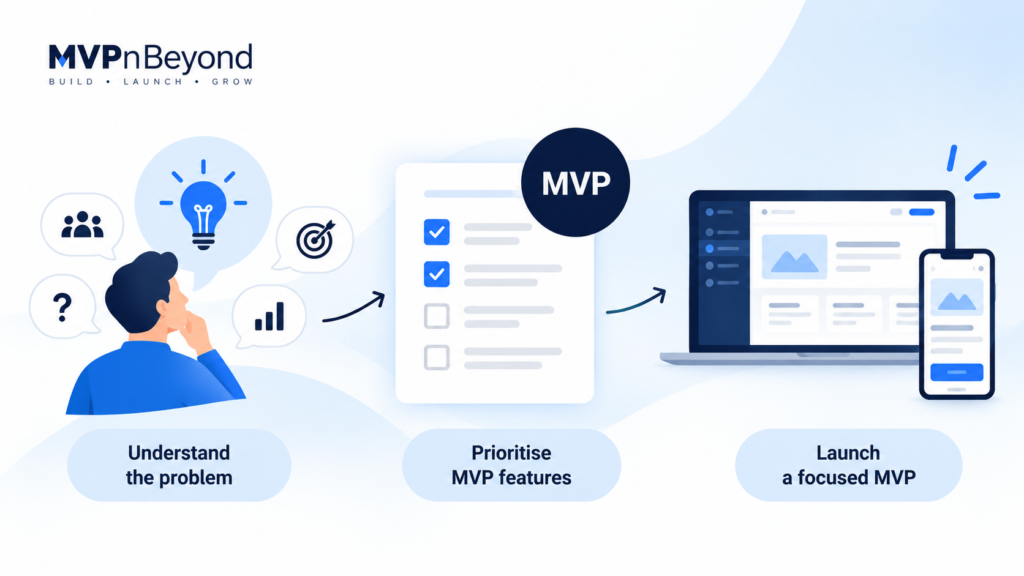
When you’re building a new software product, deciding what to include in the first release can be harder than coming up with the idea itself.
You want your product to be useful, competitive, and ready for real users. You may also have a long list of features you’d like to build. The challenge is deciding which of those features are genuinely necessary now and which can wait.
That’s where a Minimum Viable Product (MVP) comes in.
An MVP is an initial version of a product that delivers meaningful value to a specific group of users while allowing you to learn from real-world use. It isn’t simply a stripped-down version of your final vision, nor is it an excuse to launch something incomplete or unreliable.
The right MVP balances three things: a clear user problem, a usable core experience, and a practical way to validate your assumptions.
Here are seven common mistakes to avoid when deciding what your MVP should include.
- Trying to Build Too Many Features at Once
This is one of the most common mistakes in early-stage product development.
A founder starts with a core idea, then adds user profiles, dashboards, notifications, advanced reports, integrations, messaging, analytics, and several other features. Each addition seems reasonable on its own. Together, they can turn a focused MVP into a much larger and more expensive project.
The problem isn’t that these features are bad ideas. It’s that you may not yet know which ones users actually need.
What to do instead
Identify the smallest set of capabilities that allows your target user to solve the primary problem successfully.
For example, an initial appointment-booking product might need service listings, availability, booking confirmation, and basic booking management. Loyalty points, advanced analytics, automated campaigns, and complex integrations might be introduced later if users and business needs justify them.
Before adding a feature, ask:
- Is it essential to the core user journey?
- Does the product fail to deliver its main value without it?
- Is there evidence that users need it in the first release?
If the feature can wait without undermining the product’s purpose, consider postponing it.
- Building Without Clearly Defining the Target User
A product designed for everyone often becomes unnecessarily complicated.
Different users have different expectations, workflows, budgets, and priorities. Trying to accommodate all of them in the first release can expand the scope before you’ve validated the core idea.
Imagine you’re developing a task-management application. Freelancers, parents, students, and enterprise teams may all need task management, but their workflows and requirements can be very different.
An MVP designed for independent consultants might focus on task organisation, deadlines, client projects, and a simple overview of upcoming work. An enterprise product could require team permissions, approvals, audit trails, and extensive reporting.
Trying to satisfy both audiences from day one may lead to a product that is harder to build and harder to explain.
What to do instead
Choose an initial audience with a clearly defined problem. Understand how they currently work, what frustrates them, and what would make them change their existing process.
You can expand to other user groups later. First, make sure the product works well for the audience you’re trying to serve.
- Confusing an MVP with a Prototype
A prototype and an MVP serve different purposes.
A prototype helps you explore an idea, demonstrate a proposed experience, and gather feedback before committing to full development. It might consist of wireframes, clickable screens, or a simulated workflow.
An MVP, by contrast, is a working product that delivers its intended core value to real users. Depending on the product, it may need authentication, persistent data, business rules, integrations, or an administration interface.
For example, a clickable prototype of a booking application can demonstrate how a customer selects a service and chooses a time slot. But a working MVP may also need to prevent double bookings, save reservations, notify the service provider, and handle cancellations.
Confusing the two can lead to unrealistic expectations about development time, cost, and launch readiness.
What to do instead
Decide what you need to learn first.
If you’re unsure whether users understand the proposed workflow, a prototype may be enough. If you need to test whether people will use the product repeatedly or pay for its functionality, you’ll likely need a working MVP with the necessary supporting systems.
Sometimes the best approach is to validate the experience with a prototype before investing in the functional product.
- Ignoring the Complete Core User Journey
An MVP can have very few features and still be incomplete.
The important question is whether a user can move from their initial need to a meaningful outcome without encountering a dead end.
Consider a platform that helps businesses create and manage service bookings. It might have an attractive dashboard and a booking form, but what happens after someone submits a booking? Is the reservation saved? Can the business see it? Does the customer receive confirmation? Can a booking be changed or cancelled when necessary?
If essential steps are missing, the product may look finished in a demonstration but fail during actual use.
What to do instead
Map the primary user journey from beginning to end.
Identify what the user needs to do, what the system must handle, and what outcome confirms that the workflow has succeeded. Include the essential supporting functions needed to make that journey reliable.
You don’t need every possible workflow in the first release. You do need the main workflow to work.
- Treating Design and Usability as Optional
Because an MVP has a limited scope, it’s tempting to postpone design until later.
But a product doesn’t have to include dozens of features to create a frustrating experience. Confusing navigation, unclear actions, poor mobile layouts, and inconsistent screens can make even a simple product difficult to use.
This matters particularly when you’re testing a new idea. If users struggle to understand the interface, you may mistake a usability problem for a lack of interest in the underlying product.
What to do instead
Prioritise usability within the core experience.
Make the primary actions easy to find, provide clear feedback when users complete an action, handle errors gracefully, and ensure the interface works on the devices your audience is likely to use.
You don’t necessarily need an elaborate design system or extensive animations. You do need an experience that helps users accomplish their goals without unnecessary friction.
A focused MVP can have a simple design while still feeling coherent and trustworthy.
- Cutting Corners on Reliability, Security, or Essential Technical Foundations
Keeping the initial scope small is sensible. Ignoring important technical requirements is not.
Some founders assume that because the product is an MVP, they can postpone almost everything related to testing, security, data handling, and technical architecture.
That can create problems once real users and real business information enter the system.
For example, an MVP handling personal information still needs appropriate access controls and data protection. A booking product still needs to prevent conflicting reservations. A business platform may need reliable backups and a way to recover from failures.
The exact requirements depend on the product, its users, the information it handles, and the consequences of something going wrong.
What to do instead
Distinguish between advanced capabilities that can wait and foundational requirements that the product needs from day one.
You may be able to postpone advanced analytics or complex integrations. You shouldn’t automatically postpone essential security controls, data integrity, error handling, or testing of critical workflows.
Choose a technical foundation appropriate to the product’s expected use and foreseeable next steps. The goal isn’t to overengineer the MVP; it’s to avoid preventable problems that undermine trust or make future development unnecessarily difficult.
- Launching Without Knowing What You Want to Learn
An MVP should help you answer important questions about your product.
Yet some teams define success as simply completing development and releasing the application. Once it launches, they have no clear way to determine whether users find it valuable or what should be improved next.
Without a plan for learning, feature decisions can become a series of guesses rather than responses to evidence.
What to do instead
Define a small number of meaningful success criteria before launch.
Depending on your product, these could include:
- Whether users complete the primary workflow successfully.
- How many invited users activate their accounts.
- Whether users return to use the product.
- How much time or effort the product saves.
- Whether prospective customers are willing to pay.
- Which steps create confusion or prevent completion.
Choose measures that relate to the problem you’re solving. A business workflow platform may need to demonstrate time savings, while a consumer application may need to understand activation and repeat usage.
Also make a plan for collecting feedback and reviewing the results. The purpose isn’t to prove that your original idea was right. It’s to learn what needs to change.
So, What Should an MVP Actually Include?
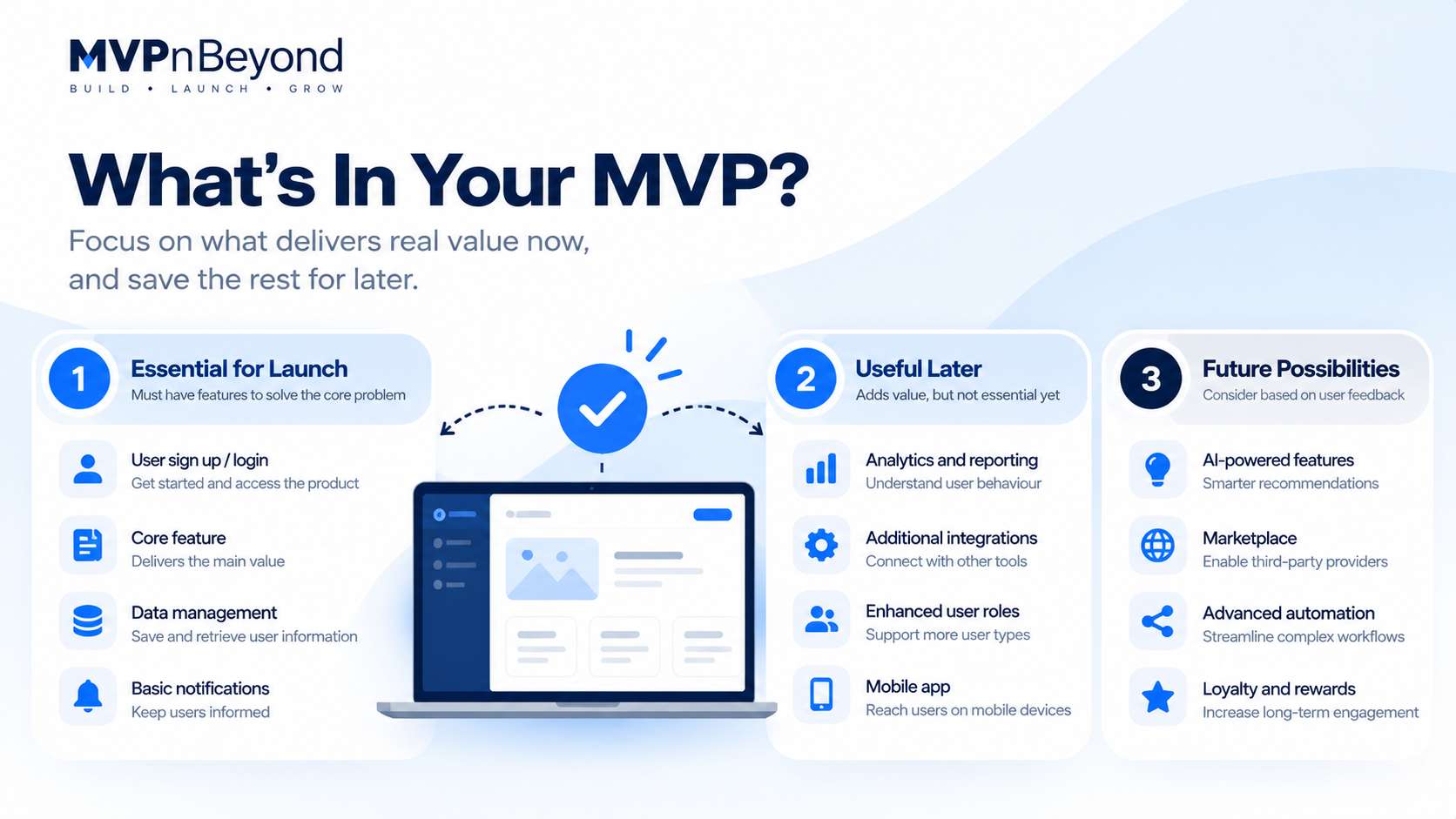
There isn’t a universal feature checklist that works for every product. A useful MVP depends on the target user, the problem being solved, the business model, and the risks involved.
However, most MVPs need to address a few fundamental areas:
A clearly defined core problem: The product should have a specific purpose and an initial audience.
A complete primary workflow: Users should be able to accomplish the main task the product promises to support.
Essential supporting functionality: Include the necessary data handling, account access, notifications, integrations, or administration capabilities required by the core workflow.
A usable and reliable experience: The first release should be understandable, tested, and appropriate for its intended users.
A way to learn from real use: Establish how you’ll gather feedback and evaluate whether the product is delivering value.
Everything else should be assessed in context. Some products need payment processing from day one; others don’t. Some require complex permissions; others can start with a single user role. Some need a mobile application, while a web application may be sufficient for the first release.
The objective is not to make every MVP look the same. It’s to make deliberate decisions about what your particular product needs.
Before You Start Development
Before committing to your MVP scope, review your proposed features and ask five questions:
- Who is the first version being built for?
- What is the main problem it must solve?
- What is the minimum complete journey that delivers value?
- Which features or technical requirements are essential from day one?
- What do we need to learn after launch to decide what comes next?
If you can answer these questions clearly, you’ll have a stronger foundation for estimating the work, planning the budget, and making informed trade-offs.
A well-defined MVP isn’t about building the cheapest or smallest product possible. It’s about investing in the right capabilities first, delivering a useful experience, and creating a foundation for evidence-led improvements.
Build enough to solve a real problem. Launch with a purpose. Then let what you learn guide the next stage of development.
Planning your MVP?
At MVPnBeyond, we work with founders and businesses to define, design, and develop web and mobile products with a clear focus on the problem being solved and the path beyond the initial release.
If you’re working through your own feature list or need help turning an idea into a practical development plan, get in touch with MVPnBeyond to discuss your project.

GOT AN IDEA TO DISCUSS?
Let’s build something meaningful.
Whether you’re launching an MVP, scaling an existing platform, or exploring AI-powered opportunities, we’d love to hear about your vision.
No obligation. Usually respond within 1 business day.