MVP
How to Decide What to Build First in Your MVP
A practical guide for startup founders on defining an MVP, prioritising features, validating assumptions, and deciding what to build first—without overcomplicating the initial release.
From Idea to MVP : How to Decide What to Build First
You have an idea for a software product. You know the problem you want to solve, you have a picture of how the product might work, and you probably already have a list of features you’d love to include.
But where should you actually start?
One of the biggest challenges in building a Minimum Viable Product (MVP) isn’t the technology. It’s deciding what belongs in the first release, what can wait, and what you need to learn before investing further in development.
Build too much, and you risk spending months developing features your users may never need. Build too little without a clear purpose, and you may end up with a product that doesn’t solve the problem well enough to be useful.
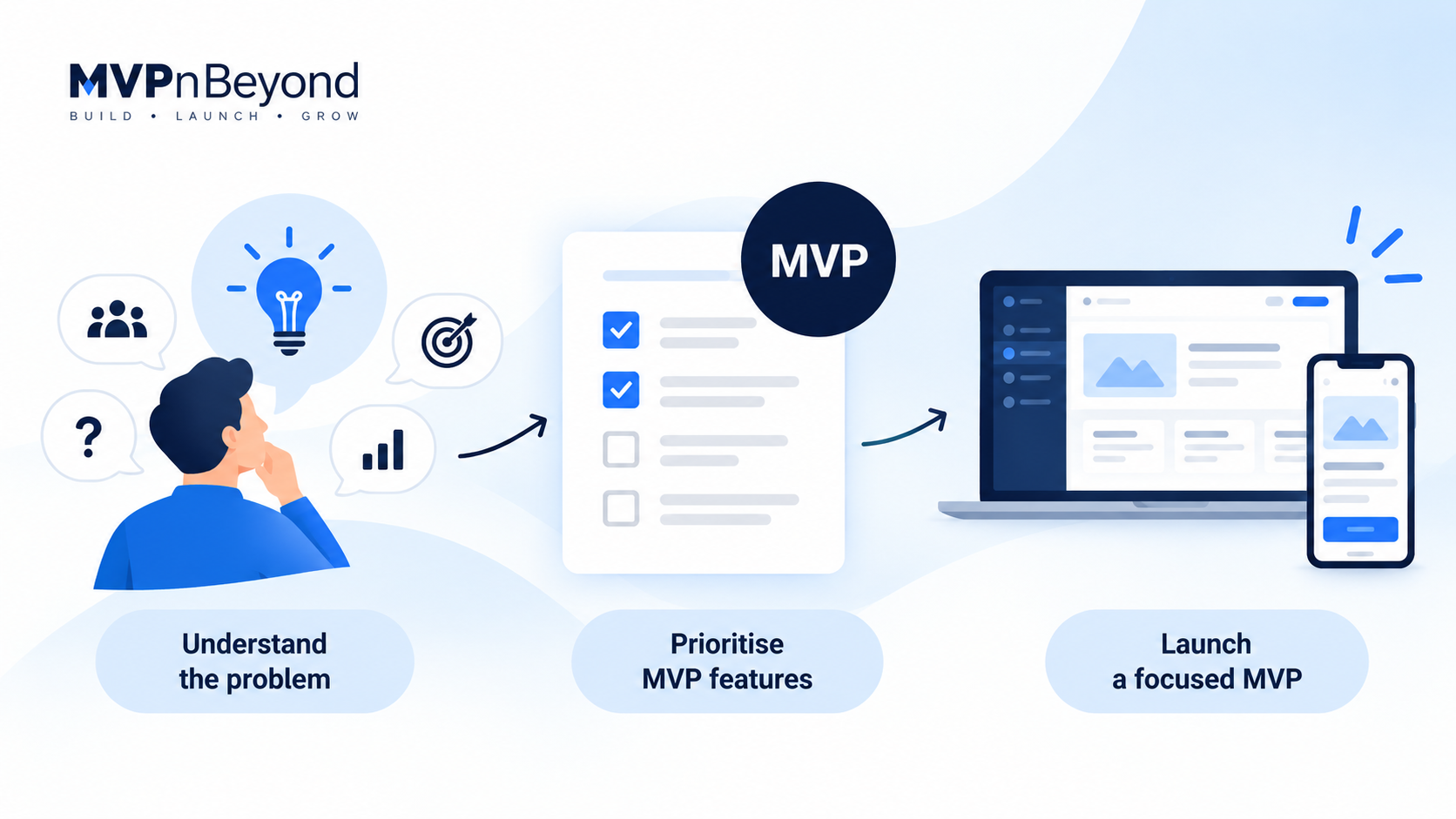
The goal is to find the right balance: a focused first version that solves a meaningful problem, delivers value to its intended users, and helps you make better decisions about what comes next.
Here’s how to approach it.
1. Start with the problem, not the features
When founders describe a product idea, they often start with a feature list.
An app with user profiles, dashboards, notifications, payments, messaging, analytics, and an administration panel might sound like a reasonable starting point. But before deciding which features to build, it’s worth stepping back and asking a more fundamental question:
What specific problem will this product solve, and for whom?
Try to describe the problem in a few sentences:
- Who experiences this problem?
- What are they trying to accomplish?
- What makes the existing process difficult, slow, expensive, or frustrating?
- How are they solving it today?
For example, imagine you’re building a platform to help schools manage student transportation.
The initial idea might include parent apps, driver tracking, automated notifications, attendance, route optimisation, payments, and reporting.
But the underlying problem might be much simpler: school administrators struggle to coordinate daily transport schedules and communicate changes reliably.
That distinction matters. It gives you a starting point for deciding which capabilities are essential and which are simply possibilities for the future.
Before writing a feature list, make sure you can clearly explain the problem you’re solving.
2. Identify your first target users
A product designed for everyone is difficult to validate with anyone.
Even if your long-term market is broad, your first version should focus on a specific group of users with a recognizable need.
Consider a meal-planning app. Its potential audience could include busy professionals, families, athletes, people with dietary restrictions, and anyone trying to eat more healthily.
Trying to serve all these groups equally from day one can quickly expand the scope. Each group may need different personalization, content, workflows, and supporting features.
Instead, you might begin with busy professionals who want to plan weekday meals quickly.
That focus helps answer practical product questions:
- Which features matter most?
- What information should users provide?
- What should the main user journey look like?
- How will you know whether the product is useful?
You don’t have to exclude other audiences permanently. You’re simply choosing where to start so that the first release has a clear purpose.
3. Map the core user journey
Once you understand the problem and your initial audience, map the shortest meaningful journey through your product.
Ask yourself: what does a user need to do to get value from this product for the first time?
For a meal-planning app, that journey might look like this:
- Create an account.
- Select dietary preferences.
- Discover suitable recipes.
- Add meals to a weekly plan.
- Generate a shopping list.
This journey gives you a practical basis for defining the first release.
Some supporting capabilities may be necessary from the beginning, such as saving a meal plan or managing basic account details. Others, such as social sharing, advanced nutritional analytics, or AI-powered recommendations, may be useful later without being essential to the initial experience.
The important distinction is between a feature that supports the core journey and one that adds value only after the core experience works well.
Map the journey before estimating development effort. It’s much easier to identify unnecessary complexity when you can see how the product is expected to work from beginning to end.
4. Separate essential features from future enhancements
Not every good idea belongs in your MVP 🙂
A practical way to organize your requirements is to divide them into three groups.
Essential for the first release
Features required to solve the primary problem and deliver a usable experience. Without these, the product cannot fulfil its main purpose.
Useful, but not essential yet
Features that improve convenience, efficiency, or engagement but aren’t necessary to validate the core idea.
Future possibilities
Advanced functionality that may become valuable once you understand user behaviour, business requirements, and product priorities more clearly.
For example, an initial booking platform may need service listings, availability, booking confirmation, and basic booking management. Loyalty programmes, advanced reporting, automated marketing campaigns, and complex integrations could potentially follow later.
However, the categories depend on the business model. Payment processing might be essential for one booking product but unnecessary for another during early validation.
Avoid treating prioritization as a universal checklist. Evaluate each feature in the context of the problem, the intended users, and the product’s business requirements.
A useful question to ask about every proposed feature is:
If we leave this out of the first release, can the product still deliver its primary value?
If the answer is yes, consider postponing it.
5. Validate important assumptions before investing heavily
An MVP is not simply a smaller version of the final product. It’s also a way to test whether your assumptions about the product and its users hold up.
You may believe users want a particular workflow, that businesses will pay for a certain capability, or that a proposed process will save time. These assumptions deserve attention before they become expensive development commitments.
Depending on the product, early validation could involve:
- Speaking with prospective users about their current problems.
- Reviewing existing tools and alternative solutions.
- Creating wireframes or a clickable prototype.
- Demonstrating the proposed workflow to potential customers.
- Testing whether users understand the value proposition.
- Exploring willingness to pay before building a complete commercial platform.
You don’t need to validate every detail before development begins. Focus on the assumptions that could materially change the product’s direction or business viability.
For example, if your product depends on users completing a multi-step process, a prototype can help reveal usability issues before the full workflow is implemented.
If the business depends on companies paying for a particular service, conversations with potential buyers may be more valuable than building additional features.
The earlier you discover a flawed assumption, the less expensive it is to respond.
6. Don’t confuse a focused MVP with a poorly built product
Reducing scope doesn’t mean compromising everything else.
An MVP can have a limited feature set and still require thoughtful design, reliable functionality, appropriate security, and a sound technical foundation.
Some shortcuts are reasonable in an early release. Others can create problems that are difficult to fix later.
For example, you might initially support one user role rather than a complex permission system. But if the product handles sensitive information, security and access controls cannot simply be postponed because the release is an MVP.
Similarly, you may begin with a limited reporting module, but the underlying data model should still support the product’s intended workflows.
Technical decisions should reflect the expected use, risks, and likely evolution of the product. Not every MVP needs a sophisticated enterprise architecture, but it should have a foundation appropriate to what you’re building.
The objective is to avoid unnecessary engineering without creating avoidable risks or making the next stage of development unnecessarily difficult.
7. Define what success looks like before launch
Before development begins, decide what you want the first release to help you learn.
Simply launching an app or website doesn’t tell you whether the product is working as intended.
Your success criteria should relate to the problem you’re trying to solve and the behaviour you expect from your initial users.
Depending on the product, you might track:
- Whether users can complete the primary workflow successfully.
- How many invited users activate their accounts.
- Whether users return to use the product again.
- How much time the product saves compared with the existing process.
- Whether prospective customers are willing to pay.
- Which parts of the experience cause confusion or abandonment.
Choose a small number of meaningful indicators rather than tracking every possible metric.
Also distinguish between technical success and business validation. A product can launch without major technical issues and still fail to attract users or demonstrate a viable business model.
Your first release should help you understand both how well the product works and whether it is solving a problem people genuinely care about.
8. Plan for what comes after the MVP
An MVP should be the beginning of a learning process, not the end of product development.
Once real users start interacting with the product, you’ll gain information that wasn’t available during planning. Some features you expected to be important may receive little attention. Other needs may emerge that you hadn’t anticipated.
Plan to review feedback, usage patterns, technical issues, and business outcomes after launch.
Use those findings to decide what comes next:
- Improve parts of the existing experience.
- Address usability or reliability issues.
- Introduce features that users genuinely need.
- Refine pricing or the business model.
- Improve performance as usage grows.
- Revisit technical decisions when there is a clear reason to do so.
This is where a focused MVP can be especially valuable. Rather than committing substantial time and budget to a long list of assumptions, you create a foundation that allows you to make more informed decisions as the product evolves.
Bringing it all together
Deciding what to build first requires more than cutting features from a large specification. It means understanding the problem, choosing your initial users, mapping the core journey, validating important assumptions, and defining what you need to learn from the first release.
Before moving into development, make sure you can answer five questions:
- What specific problem are we solving?
- Who are we solving it for first?
- What is the minimum complete journey that delivers value?
- Which assumptions should we validate before investing further?
- How will we measure whether the first release is successful?
If these answers are clear, you’ll have a much stronger basis for estimating scope, planning development, and making informed trade-offs.
You don’t need to build everything at once. You need to build the right things first, learn from the results, and improve the product based on what you discover.
Building beyond the MVP starts with making better decisions about the MVP itself.
Planning your own MVP?
At MVPnBeyond, we work with founders and businesses to turn product ideas into practical, scalable web and mobile applications. From defining the initial scope and user experience to development, launch, and ongoing improvements, the focus is on building a product that solves a real problem and can evolve with your business.
Explore our MVP development services or get in touch to discuss your idea.



GOT AN IDEA TO DISCUSS?
Let’s build something meaningful.
Whether you’re launching an MVP, scaling an existing platform, or exploring AI-powered opportunities, we’d love to hear about your vision.
No obligation. Usually respond within 1 business day.