

AI
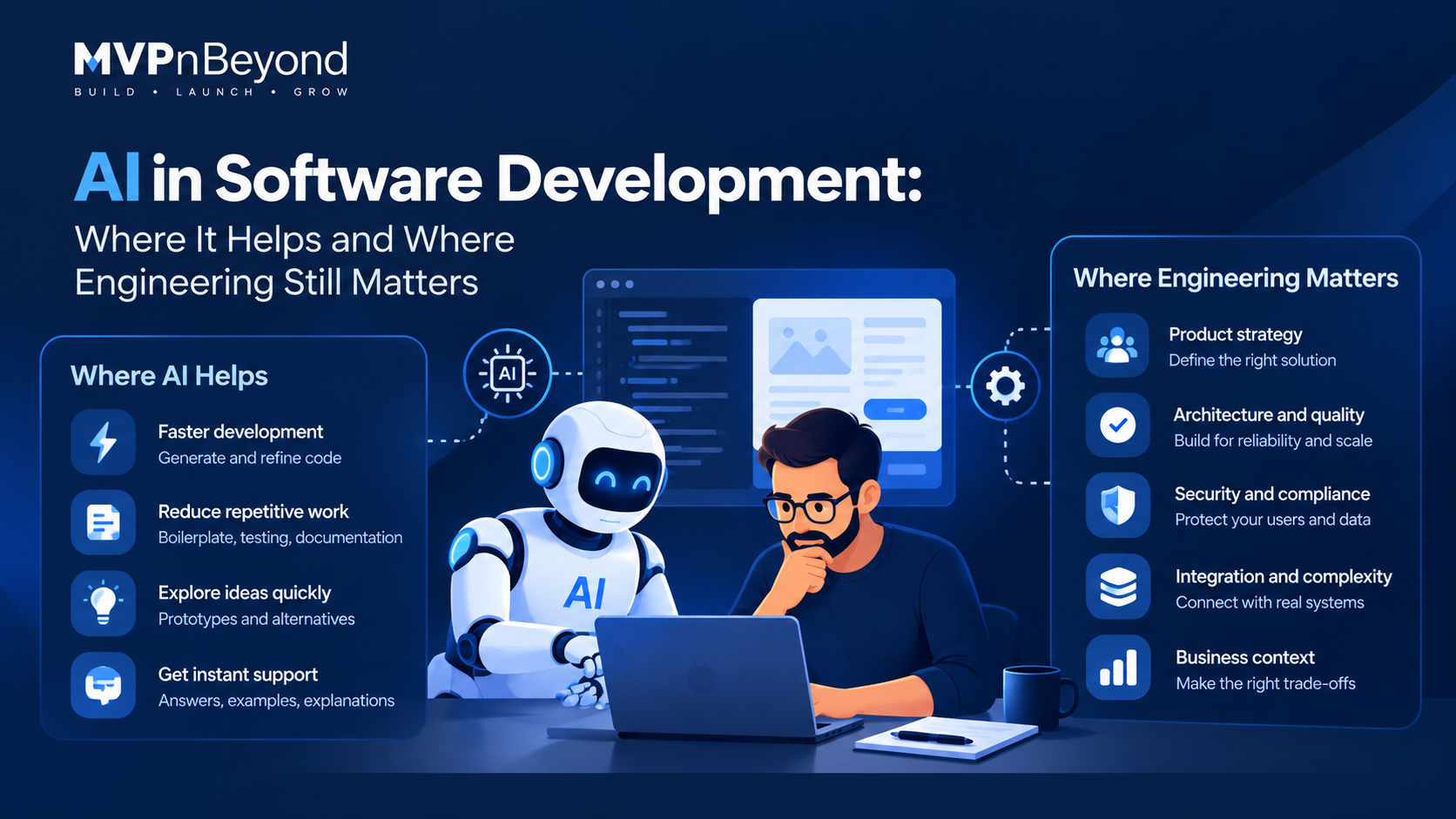
AI in Software Development: Where It Helps and Where Engineering Still Matters
AI can accelerate coding, prototyping, and testing—but reliable software still depends on good engineering. Explore where AI helps, where human judgment matters, and how startups can use both effectively.
AI in Software Development: Where It Helps and Where Engineering Still Matters
Artificial intelligence is changing how software is designed, developed, tested, and maintained. Tasks that once required hours of manual work can now be accelerated with AI-assisted tools, from generating code and creating prototypes to writing tests and documenting existing systems.
For startups and growing businesses, this creates exciting opportunities. Teams can explore ideas faster, shorten development cycles, and make better use of limited time and budgets.
But faster code generation doesn’t automatically mean a better product.
Software development involves much more than writing code. It requires understanding business requirements, making architectural decisions, managing data, protecting users, integrating systems, and ensuring that everything works reliably together.
The real opportunity is to combine AI’s speed and flexibility with sound engineering practices.
Let’s look at where AI can help, where engineering expertise remains essential, and how businesses can make practical use of both.
1. Where AI Can Make Software Development Faster
AI tools can assist with a growing range of development tasks. Their value is often greatest when they accelerate repetitive work or help developers explore possible solutions.
Code generation and implementation
AI coding assistants can generate code snippets, suggest implementations, explain unfamiliar code, and help developers work through common programming tasks.
For example, a developer building a web application might use AI to generate a basic form, create an API endpoint, or implement a reusable interface component. Instead of starting from scratch, the developer can review the generated code, adapt it to the project’s requirements, and integrate it into the existing application.
This can reduce the time spent on routine implementation.
However, generated code still needs to be reviewed for correctness, maintainability, security, and compatibility with the rest of the system.
Prototyping and UI development
AI-powered design and development tools can help teams explore layouts, create initial screens, and turn product concepts into interactive prototypes.
This is particularly useful during early product development, when founders need to communicate an idea, compare alternative approaches, or gather feedback before committing to a full implementation.
For example, a startup could use an AI-assisted tool to visualise a dashboard or booking workflow before deciding how it should be built into the production application.
The prototype helps make the idea tangible. It doesn’t necessarily provide the data handling, business logic, integrations, or reliability required for a live product.
Testing and debugging assistance
AI can help generate test cases, explain error messages, identify potential causes of bugs, and suggest possible fixes.
It can also assist with creating unit tests for individual functions or exploring edge cases that developers might otherwise overlook.
These capabilities can improve the development workflow, particularly when combined with automated testing and code review.
However, tests generated by AI may be incomplete or may simply confirm the behaviour of incorrectly implemented code. Developers still need to verify that the tests reflect the intended requirements.
Documentation and understanding existing code
AI can summarise functions, explain complex logic, draft technical documentation, and help developers navigate unfamiliar codebases.
This can be useful when maintaining older applications, onboarding developers to an existing project, or investigating how different parts of a system interact.
The quality of the result depends on the context available to the tool. Important assumptions, dependencies, and business rules may not be obvious from the code alone, so the output should be checked against the actual application.
2. Faster Development Starts with Clear Requirements
AI tools can generate a solution quickly, but they cannot reliably compensate for a poorly defined problem.
Consider a founder who wants to build a platform for managing appointments. The initial request might be to create a calendar, booking form, and dashboard.
But several important questions remain:
- Can multiple customers book the same time slot?
- Are bookings automatically confirmed or manually approved?
- Can users reschedule or cancel appointments?
- What happens when a payment fails?
- Which notifications should be sent, and when?
- What permissions should customers, staff, and administrators have?
These decisions influence the product’s workflows, data model, integrations, and implementation.
If requirements are unclear, AI may produce something that looks correct but handles important business scenarios incorrectly.
The practical approach is to clarify the problem and define the expected behaviour before relying on AI to implement it.
AI can then help turn those requirements into prototypes, code, tests, and documentation. Clear inputs make it easier to evaluate whether the output is actually right.
3. Architecture Still Matters
A working feature is not necessarily a well-designed system.
As an application grows, different components need to work together consistently. The way data is structured, APIs are designed, permissions are enforced, and responsibilities are separated can affect performance, maintainability, and the cost of future changes.
AI can suggest architectures, generate database schemas, and propose ways to structure an application. These suggestions can be useful starting points, but they aren’t automatically appropriate for the product.
For example, a simple internal tool may work well with a relatively straightforward architecture. A multi-tenant SaaS platform handling multiple organisations, user roles, billing, reporting, and sensitive data may require more careful decisions about isolation, access control, and data integrity.
The right architecture depends on the product’s requirements, risks, expected usage, and likely evolution.
Engineering expertise helps determine which complexity is necessary, which can be avoided, and where today’s shortcuts might create tomorrow’s problems.
The goal isn’t to design an elaborate system before it’s needed. It’s to make deliberate technical decisions that support the product without unnecessary complexity.
4. AI-Generated Code Still Needs Testing and Review
One of the risks of AI-assisted development is that plausible-looking code can conceal incorrect assumptions or subtle defects.
A generated implementation might handle the usual scenario correctly but fail when data is missing, a request is repeated, a user lacks permission, or an external service becomes unavailable.
These problems matter because real users don’t always follow the ideal workflow.
A reliable development process should include appropriate checks, such as:
- Code review: Check whether the implementation follows the intended design and coding standards.
- Automated tests: Verify important functions, business rules, and expected behaviours.
- Integration testing: Check that connected components and external services work together correctly.
- Security review: Examine authentication, authorisation, data handling, dependencies, and other relevant risks.
- User acceptance testing: Confirm that the product supports real business workflows as expected.
The level of testing should reflect the application’s complexity and risk. A small prototype doesn’t need the same process as a production system handling financial or health-related information.
AI can assist with several of these activities, but responsibility for the final quality remains with the people building and maintaining the product.
5. Security and Data Privacy Cannot Be Afterthoughts
AI-assisted development introduces questions about both the security of the software being built and the way development teams use AI tools.
Generated code may contain vulnerabilities, weak access controls, unsafe handling of user input, or dependencies that require closer examination. These risks need to be assessed like any other implementation decision.
There is also a separate concern: the information shared with AI tools.
Source code, credentials, customer records, internal documentation, and business-sensitive information may be subject to contractual, regulatory, or organisational restrictions. Teams should understand the data-handling terms and settings of the tools they use and follow appropriate policies for sensitive information.
For production applications, security requirements should be considered during design and implementation—not added only after a problem appears.
AI can help developers identify potential risks and understand security practices. It should be part of a disciplined process rather than a substitute for one.
6. AI Tools Don’t Eliminate the Need for Human Judgment
AI is good at generating possibilities, recognising patterns, and assisting with tasks for which it has sufficient context. But software projects also involve trade-offs that depend on business priorities and real-world constraints.
Should a feature be built now or postponed? Is a particular integration worth its maintenance cost? Is a quick implementation acceptable, or will it create a significant reliability risk? Does a proposed workflow actually solve the customer’s problem?
These aren’t purely coding questions.
They require an understanding of the users, the business model, the existing systems, and the consequences of different decisions.
Human judgment is also important when evaluating AI output. Developers need to decide whether a suggested solution is correct, whether it fits the existing codebase, and whether it introduces unnecessary complexity.
In practice, AI is most useful when it supports informed decisions rather than making unreviewed decisions on behalf of the team.
7. What This Means for Startups and MVP Development
For startups, AI-assisted development can create opportunities to test ideas more efficiently. It may help teams explore designs, implement selected features, automate routine tasks, and iterate on feedback more quickly.
But the benefit depends on how the tools are used and what the product requires.
A focused MVP with a clear workflow may be a good candidate for AI-assisted prototyping and implementation. A product involving complex integrations, sensitive information, intricate business rules, or an existing legacy codebase may require more planning, validation, and careful integration.
AI can also change where development effort is spent. Some implementation tasks may take less time, while requirements clarification, architecture, testing, review, and integration remain important.
For founders, the useful question isn’t simply whether AI can make development faster. It’s how AI can help deliver a reliable product that solves the right problem, within realistic time and budget constraints.
A practical approach is to:
- Define the core problem and the users you’re serving.
- Establish the requirements and essential workflows.
- Use AI where it provides a clear advantage.
- Review generated code and test the complete product.
- Gather feedback and improve the product based on evidence.
This keeps the focus on outcomes rather than the amount of code produced.
Finding the Right Balance
AI is becoming a valuable part of modern software development. It can accelerate implementation, support prototyping, assist with testing, and make unfamiliar code easier to understand.
But a successful product still depends on good decisions: understanding the problem, choosing an appropriate solution, building reliable workflows, protecting data, and validating the result with real users.
The most effective approach isn’t to choose between AI and engineering expertise. It’s to combine them.
Use AI to reduce repetitive work and explore solutions faster. Use engineering judgment to determine what should be built, how the pieces should fit together, and whether the finished product is reliable enough for its intended use.
The goal isn’t simply to develop software faster. It’s to build the right software, with better use of time and resources, and a clear path to what comes next.
Exploring AI for your software product?
At MVPnBeyond, we help startups and growing businesses plan, design, and develop web and mobile applications. We use appropriate tools and technologies—including AI-assisted approaches where they add value—to support practical product development without losing sight of quality, maintainability, and business goals.
Get in touch with MVPnBeyond to discuss your product idea or development challenges.


GOT AN IDEA TO DISCUSS?
Let’s build something meaningful.
Whether you’re launching an MVP, scaling an existing platform, or exploring AI-powered opportunities, we’d love to hear about your vision.
No obligation. Usually respond within 1 business day.