

STARTUPS
How Much Does It Cost to Build an App? What Founders Should Know
How much does it cost to build an app? Understand the factors that influence development costs, from features and platforms to integrations, testing, and ongoing maintenance, so you can plan a realistic budget for your product.
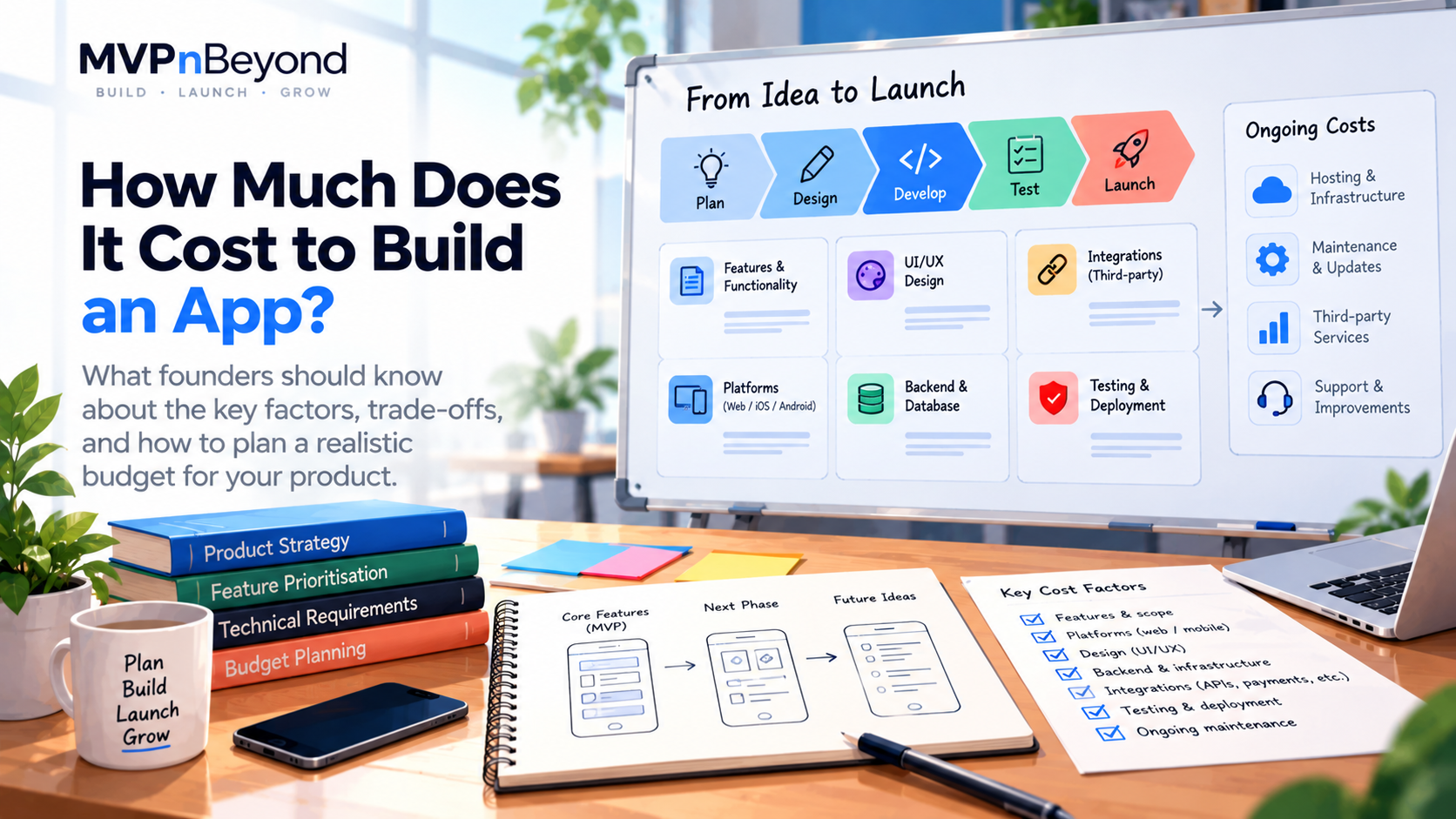
One of the first questions founders ask when planning a new software product is: how much will it cost to build?
It’s an important question, but there isn’t a single price that applies to every app. A relatively simple application with a few core screens can require a very different level of effort from a platform with multiple user roles, complex business workflows, third-party integrations, and separate mobile and web applications.
The final cost depends on what you’re building, who will use it, how it needs to work, and the quality and reliability required at launch.
The challenge is not simply finding the cheapest development option. It’s understanding what you’re paying for, deciding what the first version genuinely needs, and planning a budget that accounts for both development and the work that follows.
Here are the key factors founders should understand before budgeting for app development.
1. Start by Defining What You’re Building
Before estimating the cost, you need a reasonably clear picture of the product.
Consider two examples.
The first is a simple appointment-booking app where users can browse services, select a time, and receive a confirmation.
The second is a healthcare platform with patient profiles, practitioner accounts, appointment management, secure records, notifications, payments, and an administration system.
Both might be described as apps, but their requirements—and the effort needed to build them—are substantially different.
Even within the same product category, complexity can vary considerably.
Start by answering a few questions:
- Who will use the application?
- What problem will it solve?
- What are the essential user journeys?
- Does it require registration, profiles, or different user roles?
- Does it need a backend, database, or administration panel?
- Which external services must it connect to?
- Are there security, privacy, or regulatory requirements?
- Does it need to support offline usage, real-time updates, or complex workflows?
You don’t need a complete technical specification before starting a conversation with a development team. However, the clearer your initial requirements, the more meaningful the estimate is likely to be.
2. Understand the Difference Between an MVP and a Full Product
One of the most effective ways to manage development costs is to decide what the first version needs to accomplish.
An MVP, or Minimum Viable Product, focuses on the essential functionality needed to test a product idea with real users. It isn’t simply a smaller version of every feature you eventually want.
For example, imagine you’re developing a platform that helps businesses manage projects and teams.
Your long-term vision might include project planning, time tracking, expense management, invoicing, advanced reporting, integrations, automated workflows, and AI-assisted insights.
The first release might only need project creation, team assignments, basic status tracking, and a simple dashboard.
If those capabilities are sufficient to test whether businesses find the product useful, implementing every planned feature before launch may not be necessary.
A focused MVP can reduce the initial investment and help you learn which features deserve further development.
However, reducing scope shouldn’t mean ignoring essential requirements such as security, data integrity, usability, or reliable handling of core workflows.
The goal is to reduce unnecessary functionality, not compromise the foundations of the product.
3. Choose Your Platforms Carefully
The platforms you support can have a significant impact on the overall development effort.
Web application
A web application can be a practical starting point for SaaS platforms, business dashboards, marketplaces, and products primarily accessed through a browser.
Depending on the requirements, a responsive web application may also provide a suitable experience on mobile devices.
Mobile application
A dedicated mobile app may be appropriate when the product depends on device capabilities, push notifications, camera access, location services, frequent mobile usage, or offline workflows.
You’ll also need to consider whether the app should support iOS, Android, or both.
Web and mobile together
Some products genuinely need mobile applications alongside a web-based administration or management platform.
For example, a field-service product might need a mobile app for technicians and a web dashboard for managers.
That can be the right solution, but it introduces additional interfaces, testing requirements, and maintenance considerations.
Cross-platform frameworks such as Flutter and React Native can allow developers to share substantial portions of mobile code between platforms. However, they don’t eliminate all platform-specific work or testing.
Choose platforms according to how your users need to use the product—not simply because launching everywhere sounds appealing.
4. Know What Goes into the Development Cost
When reviewing an app development estimate, look beyond the number of screens or the quoted development hours. A software product involves several connected activities.
Product planning and requirements
This includes understanding the business problem, defining user journeys, prioritising features, and clarifying the expected behaviour of the application.
Insufficient planning can lead to misunderstandings, repeated changes, and unexpected costs later.
UI/UX design
Design involves more than making screens look attractive. It includes structuring the experience, handling different states, designing navigation, and helping users complete tasks efficiently.
The amount of work depends on the product’s complexity and how much research, prototyping, and usability testing is needed.
Frontend development
This is the interface users interact with, whether through a website, a mobile application, or both.
Interactive dashboards, complex forms, dynamic data, accessibility requirements, and responsive layouts all influence the effort involved.
Backend development and APIs
The backend typically manages business logic, authentication, data storage, permissions, integrations, and communication between different parts of the system.
A product with complex workflows or multiple user roles may require considerably more backend work than a simple application.
Administration panel
Many products need an internal interface for managing users, content, records, transactions, settings, or reports.
This work is sometimes overlooked when founders focus exclusively on what the end user sees.
Testing and quality assurance
Testing helps identify defects, verify important workflows, and check compatibility across supported devices and browsers.
The effort required depends on the application’s complexity, integrations, risk profile, and release requirements.
Deployment and launch
The product may also need production infrastructure, environment configuration, app-store preparation, analytics, monitoring, backups, and release management.
These activities should be considered when estimating the initial project, rather than treated as unexpected extras at the end.
5. Understand the Cost of Integrations and Complex Features
Some features appear straightforward from the user’s perspective but involve substantial work behind the scenes.
Consider a few examples:
Payments and subscriptions: Integrating a payment provider is only part of the work. The product may also need subscription status management, payment-failure handling, invoices, refunds, and access rules.
Real-time communication: Chat, live notifications, collaborative editing, and real-time updates can introduce additional infrastructure, synchronisation, and testing requirements.
Third-party integrations: Connecting to external systems may involve API limitations, authentication, data mapping, error handling, and ongoing compatibility changes.
Offline functionality: Supporting users without a reliable internet connection requires decisions about local storage, synchronisation, conflicts, and recovery when connectivity returns.
AI-powered features: These can introduce model or API costs, prompt and workflow design, evaluation, privacy considerations, and safeguards against unreliable outputs.
Complex reporting: Dashboards may require careful data modelling, calculations, permissions, and performance optimisation.
None of these features is automatically too expensive to include. The important point is to understand the actual requirements and prioritise them according to the value they provide.
A feature that is essential to the product’s core purpose may justify the additional investment. Another feature may be better introduced after the initial release.
6. Consider the Ongoing Costs After Launch
Development is only part of the total cost of owning a software product.
Once the application is live, it needs to be operated, maintained, and improved.
Depending on the product, ongoing costs may include:
- Hosting, databases, storage, and bandwidth.
- Third-party APIs, email services, maps, messaging, or payment services.
- Bug fixes and compatibility updates.
- Security updates and dependency maintenance.
- Monitoring, backups, and incident response.
- Customer support and operational administration.
- New features and improvements based on user feedback.
- App-store accounts or other platform-specific fees, where applicable.
The amount can vary significantly depending on usage, architecture, service providers, and support arrangements.
For example, an application with modest traffic and limited external services may have relatively low infrastructure costs. A product with extensive media storage, high traffic, or frequent third-party API calls may have a different operating profile.
It’s also useful to distinguish between maintenance and ongoing development. Keeping a product secure and functional is different from regularly adding new capabilities.
When planning your budget, consider both the initial build and how the product will be supported over the following months.
7. Compare Development Proposals Beyond the Headline Price
If you’re speaking with multiple development companies or freelancers, you may receive very different estimates for what appears to be the same product.
That doesn’t automatically mean one provider is overcharging or another is offering a better deal.
The estimates may be based on different assumptions about functionality, design, testing, technical architecture, delivery timelines, or post-launch support.
Before comparing prices, establish what each proposal includes.
Look at:
- The scope of work and explicitly included features.
- Supported platforms and devices.
- UI/UX design and prototyping.
- Backend, APIs, databases, and administration tools.
- Integrations and third-party services.
- Testing, deployment, and launch support.
- Documentation, source-code access, and intellectual property terms.
- Warranty, maintenance, and ongoing support arrangements.
- The process for handling scope changes.
A lower quote may be appropriate for a tightly scoped product with limited requirements. It may also exclude work that another proposal includes.
Likewise, a higher estimate isn’t automatically better. It should be supported by a clear scope, a credible delivery approach, and an explanation of the effort involved.
Ask each provider to identify assumptions, exclusions, and potential areas of uncertainty. This makes it easier to compare like with like and reduces the chance of disagreements during development.
8. How to Keep Your App Development Budget Under Control
You don’t need to know every detail of the final product before beginning, but you do need a sensible approach to managing scope.
Prioritise features by value
Separate essential capabilities from features that are useful but not required for the first release.
Focus on the workflows that deliver the product’s core value.
Validate assumptions early
If you’re unsure whether users need a particular feature, consider interviews, prototypes, or a small experiment before investing in full implementation.
Learning early can be less expensive than building the wrong solution.
Agree on a clear initial scope
Document the core features, expected behaviour, deliverables, and acceptance criteria. This gives the team a shared understanding of what constitutes completion.
Plan for changes deliberately
Some changes are inevitable as you learn more. The important thing is to understand their impact on cost and timelines before approving them.
A structured change process helps prevent a series of individually small requests from expanding the project significantly.
Avoid unnecessary technical complexity
Choose technologies and architecture that meet the product’s requirements without introducing complexity that has no clear benefit.
The objective is to create a reliable, maintainable product—not to use the largest possible technology stack.
Keep a contingency
Requirements may become clearer during development, and unforeseen issues can arise. Where possible, reserve part of the available budget for reasonable uncertainties rather than committing every dollar to the initial estimate.
The appropriate contingency depends on how well the scope is understood and how much technical uncertainty remains.
9. What Information Do You Need for a Useful Cost Estimate?
You don’t need a complete specification to request an initial estimate, but providing a few essentials makes the conversation much more productive.
Prepare a short outline covering:
The product idea: What problem are you solving, and for whom?
The main users: Who will use the application, and do different user types need different permissions?
The essential features: What must the first release be able to do?
The platforms: Is it a web application, a mobile app, or both?
The integrations: Does it need payments, maps, messaging, external APIs, or other services?
The design status: Do you already have wireframes, prototypes, or a design system?
The budget and timeline: What investment range are you considering, and are there important deadlines?
The future vision: What capabilities might be needed later, even if they aren’t part of the initial scope?
With this information, a development partner can help identify the major work areas, clarify assumptions, and determine whether a more detailed discovery or planning phase would be useful.
An early estimate may still have a range rather than a fixed price. That’s reasonable when important requirements are not yet fully understood.
The aim is to improve the estimate as uncertainty decreases, not to create a false sense of precision at the beginning.
Final Thoughts
The cost of building an app depends on far more than its category or the number of screens it contains.
The platforms you support, the complexity of the workflows, the backend requirements, integrations, design, testing, and ongoing maintenance all contribute to the overall investment.
For founders, the most useful starting point is to define the problem, identify the essential functionality, and understand the trade-offs involved in the proposed solution.
A focused MVP can help you launch sooner and learn from real users, provided it still delivers the core value and meets the necessary quality and security requirements.
You don’t need to build everything at once. You need a clear understanding of what you’re building first, why it matters, and how it fits into your longer-term plans.
The goal isn’t simply to spend less on development. It’s to invest in the right product, at the right stage, with a realistic plan for what comes next.
Planning an app or software product?
At MVPnBeyond, we help founders and growing businesses turn product ideas into practical development plans and working web applications, mobile apps, and SaaS platforms. We work with you to understand the requirements, prioritise the first release, and identify a sensible path from initial development to future growth.
Get in touch with MVPnBeyond to discuss your idea and the factors that will shape its development cost.


GOT AN IDEA TO DISCUSS?
Let’s build something meaningful.
Whether you’re launching an MVP, scaling an existing platform, or exploring AI-powered opportunities, we’d love to hear about your vision.
No obligation. Usually respond within 1 business day.