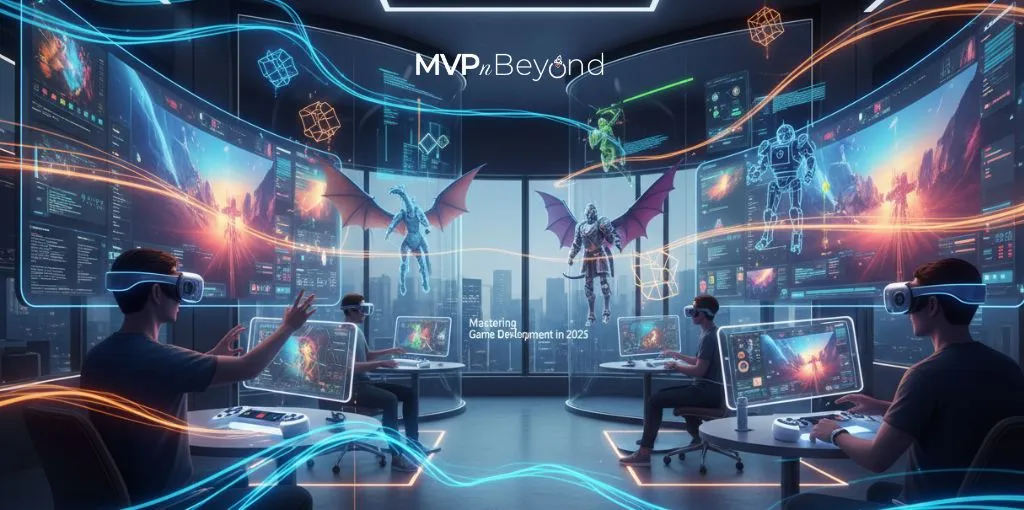
Building Games That Go Beyond the Launch

Modern game development is evolving faster than ever. It’s no longer about stunning graphics or flawless animations — it’s about scalability, performance, and adaptability. Studios today aim to build games that can grow, update, and remain engaging for years to come.
At MVPnBeyond, a leader in custom software development in Brisbane, we believe every great game blends creativity with structured engineering. Building a scalable game means thinking ahead — about your architecture, your tech stack, and your players’ evolving expectations. Let’s explore the strategies that define successful game development in 2025.
1. Start with Strategy, Not Code
Every exceptional game starts long before the first line of code. The pre-production phase sets the tone for how your project will scale and succeed.
Create a Comprehensive Game Design Blueprint
Your Game Design Document (GDD) acts as your creative guide. It defines gameplay mechanics, user experience flow, art direction, and even monetization models. Collaborative tools like Notion, Figma, or Miro help your creative and technical teams stay aligned.
Establish a Technical Roadmap
Your Technical Design Document (TDD) transforms ideas into systems. It maps frameworks, APIs, and server infrastructure, ensuring scalability from day one. This technical planning is what makes the difference between a good game and a scalable one capable of handling millions of concurrent players.
2. Build Smart with Modern Development Practices
Turning your ideas into a functioning, interactive world requires both creativity and precision.
Prioritize Clean, Scalable Code
Follow principles like SOLID, KISS, and DRY to maintain structure and readability. Modular design ensures multiple developers can work in parallel without conflicts.
Use Reliable, High-Performance Tech Stacks
Choosing the right technology is crucial for any scalable game. Frameworks like Unity or Unreal Engine combined with Node.js, React, and Firebase create seamless backends and real-time interaction layers — ideal for multiplayer environments.
Automate for Efficiency
Integrating CI/CD pipelines automates testing and deployment, minimizing errors and boosting productivity. Automation tools, often part of advanced software development services, streamline updates and reduce downtime.
3. Streamline Asset Pipelines for Speed and Quality
Efficient asset pipelines are the heartbeat of game performance. Poorly managed assets lead to long loading times, bloated builds, and reduced responsiveness.
Best Practices:
-
Standardize naming conventions and folder structures.
-
Automate exports with scripts for 3D assets and textures.
-
Set clear benchmarks for file sizes and poly counts.
-
Use cloud-based asset libraries for collaboration and version tracking.
When assets are optimized, your game performs better — no matter the device or region.
4. Use Version Control as Your Safety Net
For teams both large and small, version control is non-negotiable. Tools like Git (with LFS) ensure smooth collaboration, prevent overwrites, and protect project history.
Recommended Branch Strategy:
-
Main Branch: Always stable, production-ready builds.
-
Develop Branch: For integrating approved features.
-
Feature Branches: Individual components in progress.
This structure helps you maintain clarity across every sprint, update, and iteration — a best practice we emphasize in all custom software development solutions.
5. Adopt Agile for Creative Flexibility
Game development is unpredictable. Requirements evolve, mechanics change, and new features emerge. That’s why Agile methodologies like Scrum or Kanban are essential.
Short sprints allow developers and designers to test features quickly, gather feedback, and improve gameplay iteratively. At MVPnBeyond, our teams use this adaptive structure to maintain momentum and ensure every milestone delivers measurable progress.
6. Test Early, Test Often
Testing is not a final step — it’s an ongoing process throughout the entire lifecycle.
Recommended Testing Layers:
-
Unit Tests: Validate code-level functionality.
-
Integration Tests: Ensure systems interact without breaking.
-
Performance Tests: Analyze load handling and frame rate stability.
-
Playtests: Evaluate real-world enjoyment and engagement.
Continuous testing ensures your players experience smooth gameplay while reducing post-launch patch chaos.
7. Optimize for Performance and Scalability
Performance optimization is where great games stand apart. Lag or frame drops can break immersion instantly.
Optimization Tips:
-
Use Object Pooling to manage recurring assets efficiently.
-
Implement Level of Detail (LOD) models for distant visuals.
-
Optimize shaders and textures to reduce GPU load.
-
Profile builds regularly to detect and fix bottlenecks early.
These techniques are a core part of scalable software development services, ensuring your game performs seamlessly across platforms.
8. Plan for Post-Launch Longevity (LiveOps)
The day you launch your game is only the beginning. Successful studios invest heavily in LiveOps — continuous updates, player engagement, and community growth.
Post-Launch Essentials:
-
Embed analytics tools to track user behavior.
-
Develop content pipelines for quick updates.
-
Manage cloud scalability to handle player spikes.
-
Encourage player feedback through in-game surveys or Discord communities.
This consistent post-launch attention ensures your game evolves with its community — increasing retention and long-term revenue.
9. The Power of AI in Modern Game Development
AI is revolutionizing how studios build and manage games. From asset creation to live analytics, artificial intelligence simplifies complex workflows and enhances creativity.
At MVPnBeyond, one of the leading AI automation companies, we leverage AI to:
-
Generate dynamic, procedurally created environments.
-
Automate repetitive QA processes.
-
Design smarter NPC behavior for realistic interactions.
-
Analyze gameplay patterns for performance tuning.
Integrating AI reduces development time, minimizes costs, and enhances user experience — turning traditional software into intelligent, self-improving ecosystems.
10. The Future of Game Development: Connected, Scalable, and Intelligent
As 2025 unfolds, the boundaries between gaming, technology, and innovation continue to blur. The demand for custom software development in Brisbane and beyond is growing rapidly as businesses explore interactive technologies like AR, VR, and AI-driven ecosystems.
For studios, success in game development now means mastering three things:
-
Scalable architecture that can grow with user demand.
-
Automated pipelines that keep production efficient.
-
Intelligent integration using AI and data analytics.
Conclusion: Turning Creativity into Scalable Software
Game development is no longer just an art form — it’s a complete software ecosystem. The combination of structured planning, smart architecture, and AI automation defines the success of modern studios.
At MVPnBeyond, we help game developers and tech startups bring visionary ideas to life through reliable software development services. Whether it’s designing scalable infrastructure or optimizing real-time performance, our team ensures your product is ready for the global stage.
Ready to build your next high-performance game?
Partner with MVPnBeyond — your trusted partner for innovation, scalability, and speed.