When companies aim to launch apps for both iOS and Android, their key goals often revolve around reducing time-to-market, keeping development costs manageable, working with a smaller team, and ensuring the codebase can be reused for future scalability. This is where the big question arises: Which development approach should you choose, and what’s the most efficient way to build for both platforms simultaneously?
At MVPnBeyond, we’ve been helping businesses for years by delivering mobile solutionsthat meet their objectives through expert consultation and advanced engineering. In this guide, we’ll break down the best strategies for iOS and Android app development, helping you make the right choice for your needs.


Why Develop for Both Platforms?
Building apps for multiple platforms expands your audience reach, improves customer engagement, and helps you tap into broader markets. You can choose between developing two separate native apps or creating a single cross-platform app that runs on both systems. The right option depends on factors like budget, launch timeline, required features, and target audience.
1. Native App Development
Native development involves creating separate applications for each platform — for example, using Swift for iOS app development and Kotlin for Android. This method delivers outstanding performance, a smooth user experience, and deeper integration with device features. However, it typically comes with higher costs, requires two specialized teams, and makes updates more time-consuming since each app has its own codebase.
2. Cross-Platform App Development
With cross-platform frameworks such as Flutter, React Native, or .NET MAUI, developers can build a single codebase that works on both platforms. This approach shortens release timelines, lowers costs, and makes maintenance easier. While highly complex or graphics-intensive apps may occasionally perform better when built natively, modern cross-platform tools now achieve results that are nearly identical to native performance. Plus, having just one development team speeds up bug fixes and feature updates.
In summary, if maximum performance and highly tailored platform experiences are your priority, native development may be the right route. However, if you’re focused on efficiency, cost-effectiveness, and faster delivery without compromising quality, a cross-platform approach for iOS and Android app development can be a smart and scalable choice for your business.
Exploring Options for Multi-Platform Development
Multi-platform development offers significant advantages, but there’s no single solution that works perfectly for every project. The right choice depends on factors such as your business goals, technical requirements, budget, and desired features. Let’s break down two of the most popular frameworks and see how they can help you deliver apps across multiple platforms.
1. Flutter – One Codebase for Android and iOS
Introduced by Google in 2017, Flutter is a powerful and adaptable framework that allows developers to create mobile, web, and desktop applications using a unified codebase. Built on Google’s Dart programming language, it delivers smooth, consistent user experiences across platforms.
Well-Known Apps Using Flutter: Google Pay, eBay, Alibaba, ByteDance products.
Key Advantages:
-
Single reusable codebase – Build apps for Android, iOS, web, and desktop without writing separate code for each, saving both time and money.
-
Hot reload – Make changes to the code and instantly view the results without a full restart.
-
Extensive widget library – Pre-built components following Google’s Material Design make creating sleek, interactive interfaces faster.
-
Native feature integration – Access device-specific APIs and features through Flutter plugins.
-
Strong community support – Developers worldwide actively contribute tools, solutions, and improvements.
-
Near-native performance – Delivers a smooth experience suitable for most app types.
Real-World Example: Mobile CRM for Landscaping
A landscaping industry client required a mobile version of their existing web CRM to handle leads, clients, estimates, and invoices. Using Flutter, the development team built a high-performance cross-platform app with complex CRM logic, role-based permissions, and a consistent interface for both iOS and Android. The first version was delivered in just three months, proving that Flutter is an excellent choice for iOS and Android app development where speed and feature-rich functionality are both critical.
2. React Native – A Flexible Cross-Platform Choice
Developed by Meta (formerly Facebook) and released in 2015, React Native is another leading option for creating apps that run seamlessly on multiple platforms. It’s particularly popular among businesses aiming to balance development efficiency with a native-like user experience.
Popular Apps Built with React Native: Instagram, Pinterest, Skype, Walmart, Tesla, Meta Ads Manager.
Key Advantages:
-
Code reusability – Share most of the codebase across Android and iOS to speed up delivery and reduce costs.
-
Hot reloading – Make and test changes instantly without restarting the app, boosting developer productivity.
-
Native components – Maintain the look, feel, and performance of true native apps.
-
Active developer ecosystem – Access a wide range of libraries, plugins, and community-driven resources.
For teams prioritizing iOS app development alongside Android, React Native offers a smooth, cost-effective pathway that doesn’t compromise too much on the quality and responsiveness of native solutions.
MVPnBeyond’s Success Story #1: Developing a React Native App for Router Configuration
In 2020, a client approached MVPnBeyond with a request to build a React Native-based mobile solution for router setup. The objective was to provide a more intuitive, seamless experience for users, while improving service efficiency and customer satisfaction.
Objective: Create a cross-platform application for Android and iOS to help users set up and manage routers.
Industry: Services
Cooperation Model: Dedicated Development Team
Service Type: React Native Development
How We Delivered the Solution:
We began with a thorough technical consultation phase, analyzing all functional and non-functional requirements. This allowed us to map out a clear development roadmap. Since the client’s infrastructure was already built with React, React Native became the logical choice, ensuring smooth integration and simplified ongoing support.
Next, we designed a responsive and highly customizable user interface, adaptable for both mobile and tablet devices. Branding flexibility was built into the system, enabling the client to adjust colors, logos, and other visual elements without a full redevelopment. This was achieved by leveraging React Native’s robust libraries.
Integrating the application with router functionality was one of the project’s most complex challenges. Router updates required reboots, temporarily removing the device from the network. To address this, we implemented automation that handled reconnections without user intervention, creating a smooth and user-friendly experience.
The project was delivered on time and within a fixed budget. Our React Native expertise allowed us to meet strict deadlines while maintaining high-quality standards. This case highlighted how React Native can be ideal for cross-platform application development involving advanced network integrations. Its extensive library ecosystem made it easier to incorporate additional features like payment systems, live chat, and audio/video communication.
.NET MAUI for Building Mobile and Desktop Apps
Released in May 2022 by Microsoft, .NET Multi-platform App UI (.NET MAUI) allows developers to create native mobile and desktop applications using C# and XAML. As the successor to Xamarin.Forms, MAUI builds on its foundation by offering native UI controls for Android, iOS, macOS, and Windows.
Notable Apps Built with .NET MAUI: NBC Sports Next, Escola Agil, Irth Solutions.
Key Features:
-
Cross-Platform APIs: Direct access to device functionalities like GPS, accelerometer, battery status, and network connectivity.
-
Reusability: Multi-targeting enables a single project to run across Android, iOS, macOS, and Windows.
-
Hot Reload Support: Developers can instantly apply code changes while the application is running, accelerating development.
MVPnBeyond’s Success Story #2: Delivering a Complex Web & Mobile SaaS for Corporate Clients
A leading quality improvement consulting company partnered with MVPnBeyond to build a Web & Mobile SaaS platform designed to enhance employee engagement and boost performance in mid-sized and large enterprises.
Industry: Services
Cooperation Model: Dedicated Development Team
Service Type: .NET Development
How We Delivered the Solution:
The project began with in-depth business analysis. Our team created detailed requirement specifications and technical documentation, reducing potential risks, controlling costs, and establishing a clear technical vision. This phase was conducted alongside UI/UX design to define the scope. Using Material Design guidelines, we developed wireframes that captured the platform’s functionality and design.
When selecting the architecture, Microsoft Azure was chosen as the optimal environment for hosting, maintaining, and scaling the solution.
For the mobile component, we opted for Xamarin to deliver cross-platform apps for Android and iOS, reusing over 80% of the codebase. This approach saved both time and budget while supporting advanced features like dynamic language switching, which is more complex in native app development.
The end result was a fully functional product that aligned with the client’s business needs and budget. With 80% shared code, maintenance and updates became faster and more efficient.
It’s important to note that Xamarin is no longer recommended for new cross-platform development as of May 2024, and existing Xamarin applications should be migrated to .NET MAUI for long-term support.
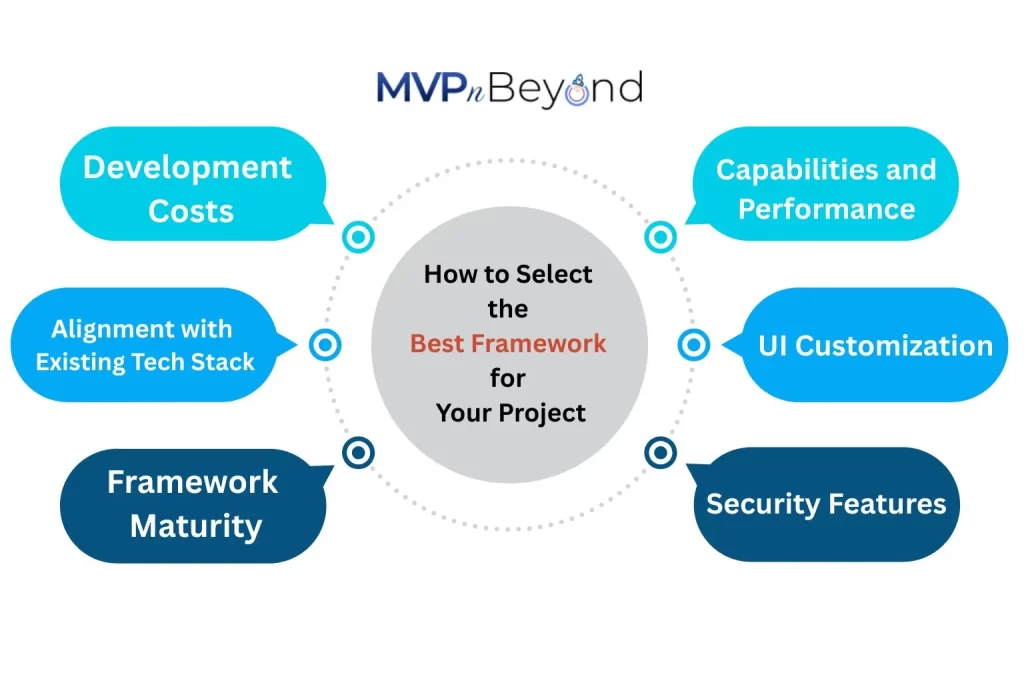
How to Select the Best Framework for Your Project
Selecting the right framework for your project goes beyond purely technical considerations—it requires a clear understanding of your business objectives. Below are essential factors to evaluate before making your choice:
1. Development Costs
Estimate the expenses of hiring developers skilled in your chosen framework. Consider salary ranges, the availability of qualified talent, and whether training or upskilling will be necessary. This is particularly important for businesses aiming for cost-efficient iOS and Android app development without compromising on quality.
2. Alignment with Existing Tech Stack
Examine how well the framework fits into your current technology ecosystem. Compatibility with your team’s existing skills, tools, programming languages, and infrastructure will make integration smoother and reduce long-term maintenance overhead.
3. Framework Maturity
Assess the stability, community support, and longevity of the framework. Mature frameworks with active developer communities tend to offer better documentation, faster updates, and consistent security patches—an important factor for reliable iOS app development and cross-platform projects.
4. Capabilities and Performance
Check whether the framework can meet your project’s unique requirements, including performance, scalability, and platform compatibility. A framework should be capable of handling your application’s workload efficiently while providing flexibility for future upgrades.
5. UI Customization
Evaluate how easily the framework allows for custom user interface designs. If your app needs a distinctive and branded look, ensure the framework supports deep customization without impacting performance or usability.
6. Security Features
Prioritize frameworks with strong, built-in security measures. Look for support for encryption, compliance with industry security standards, and protection against common vulnerabilities to safeguard sensitive user data.
By aligning these considerations with your business goals and constraints, you can confidently choose a framework that positions your project for long-term success.
Comparing the Best Cross-Platform Frameworks for a Single App on Android and iOS
It is entirely possible to migrate an existing native app to a cross-platform solution when scalability and agility are priorities. Industry leaders such as Shopify and Alibaba have successfully shifted from native development to technologies like React Native and Flutter to better serve their evolving needs.
When planning a migration, businesses should thoroughly assess the current system, prioritize which components require replacement, make informed technical decisions, and establish a detailed migration roadmap.
If you’re unsure where to start, MVP’s software architects and consultants can help match your business objectives with the right technology stack. They can also prepare a strategic development roadmap to make the iOS and Android app development process more streamlined and cost-effective.
MVPnBeyond’s Multi-Platform Development Expertise for Your Product
With the growing demand for mobile solutions, organizations now have multiple options for building apps for both Android and iOS. You may choose a native development route or opt for a cross-platform framework.
To determine which approach best fits your specific project, factors like budget, timeline, technical complexity, and target audience should be carefully reviewed. While native development can offer optimal performance, cross-platform frameworks can accelerate delivery and reduce costs—making them attractive for many iOS app development and Android projects.
As a seasoned cross-platform app development company, MVP offers flexible collaboration models tailored to your goals. Whether you need skilled mobile developers to strengthen your existing team or a dedicated unit for complete product development, we have the resources and expertise to deliver results.
From initial consultation to ongoing development and post-launch support, MVPnBeyond is ready to help you achieve your vision and select the ideal multi-platform framework for your needs. Reach out to us through your preferred channel to begin your iOS and Android app development journey with confidence.
If you’re looking for a trusted iOS app development company in Australia, or anywhere in the world, MVPnBeyond is here to bring your vision to life. Our expert team specializes in creating high-performance, user-friendly iOS applications tailored to your business needs. From strategy and design to development and launch, we ensure every step aligns with your goals. Contact us today and let’s turn your app idea into a market-ready success.

FAQ
1. Can I really create a single app that works on both Android and iOS?
Yes. With modern cross-platform frameworks, it’s possible to develop one app that runs smoothly on both Android and iOS devices. This approach saves time, reduces costs, and ensures consistent user experiences across platforms.
2. Which technologies are best for iOS and Android app development together?
Popular technologies like Flutter, React Native, and Xamarin allow developers to write code once and deploy it on both platforms. The choice depends on your app’s complexity, budget, and desired features.
3. Is a cross-platform app as good as a native app?
While native apps often have slight performance advantages, cross-platform apps can match their quality in most cases, especially when built with modern tools and optimized code. They’re ideal for businesses that need fast, cost-effective deployment.
4. How much does it cost to develop one app for both platforms?
Costs vary based on features, design complexity, and required integrations. Generally, developing a single cross-platform app is more budget-friendly than building separate native apps for Android and iOS.
5. Why should I hire a professional iOS app development company in Australia for my project?
An experienced company like MVPnBeyond understands local market needs, ensures top-quality development, and provides end-to-end services. They can guide you from concept to launch, ensuring your app succeeds on both platforms.
Also Read : How to Prioritize Features in Your AI-Powered MVP