You’ve launched your MVP, gained some early traction, and validated that there’s a need for your product. But what’s next? For many startups, the period after MVP launch is murky and riddled with uncertainty. Scaling isn’t just about adding features or growing users — it’s about evolving your product, team, and infrastructure to achieve product-market fit (PMF) and sustainable growth. Let’s breaks down what comes after the MVP and how to strategically scale in 2025.
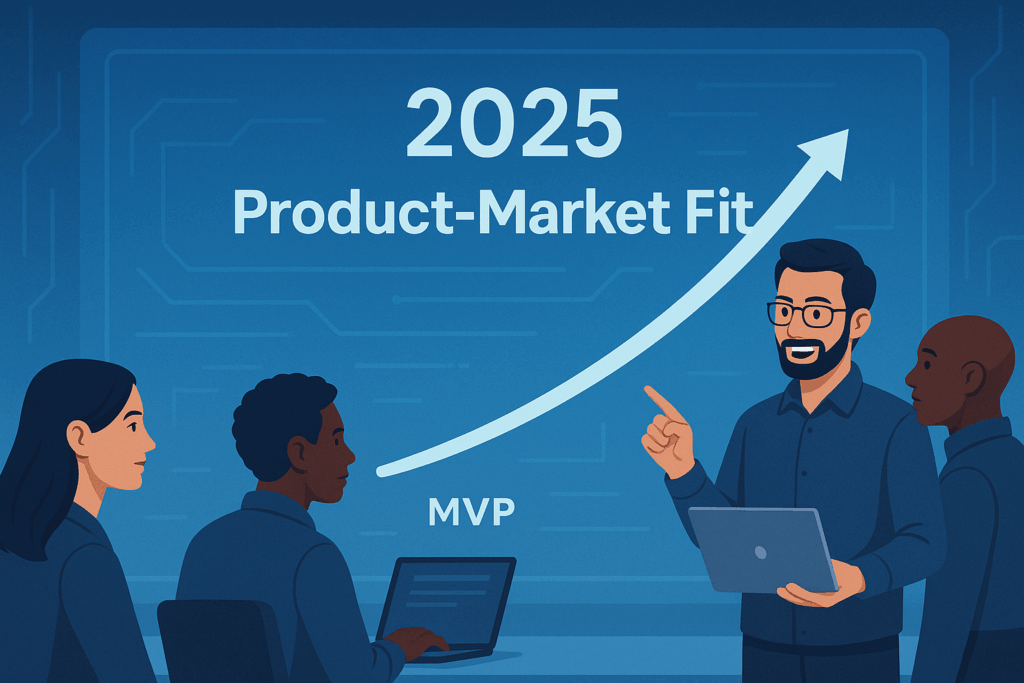
What is Product-Market Fit (PMF)?
Product-Market Fit means your product solves a real problem for a specific group of users — and those users are actively engaging, returning, and advocating for it. Achieving PMF isn’t a linear journey. It involves understanding customer pain points, iterating based on feedback, and reaching measurable retention and satisfaction metrics.
In monetary terms Product Market Fit is building something that people want—badly enough to pay for it, use it often, and tell others about it. It’s not just a buzzword; it’s a critical inflection point in a product’s lifecycle.
Signs of PMF:
- High customer retention rates
- Organic growth via referrals
- Customers expressing disappointment if the product were removed
- Clear understanding of your ideal user and their problem
Why Most MVPs Stall Before Scaling
Launching an MVP is just the beginning. But scaling too soon — or too late — is where many startups falter.
Here’s why promising products often lose momentum:
- Misinterpret early traction as readiness to scale
- Ignore customer churn signals
- Fail to adapt tech infrastructure
- Spend too early on marketing or hiring
- Lack clear PMF indicators
Signs You’re Ready to Scale
Scaling prematurely is one of the top reasons startups fail. But if you’re seeing the right signals, it might be time to grow with confidence.
Look for these markers before taking the leap:
- Have a steady flow of engaged users
- Understand core usage metrics (DAU, MAU, CAC, LTV)
- Can retain users beyond the first few days/weeks
- Have a repeatable acquisition channel
- Are solving a clear, validated problem
The Scaling Playbook: Stages & Strategies
Here’s how to move from MVP to scalable product in 2025:
1. Track the Right Signals
Use metrics like user retention (30-day+), NPS, activation rate, and conversion to monitor PMF signals.
2. Create Feedback Loops
Your early users are goldmines of insight. Use surveys, interviews, and behavior tracking to refine features and UX.
3. Scale Tech Thoughtfully
Move from monolith MVPs to scalable architectures (microservices, serverless). Prioritize automation and clean, modular code.
4. Invest in AI & Personalization
AI isn’t just a buzzword. Use it for smart onboarding, recommendations, and ops automation — but don’t force it without a use case.
5. Build the Right Team
As traction grows, start hiring across product, design, data, and DevOps. Avoid bloated teams — grow lean but strategically.
6. Revisit Your Funding Strategy
Use MVP traction to raise smart capital. Have a clear story around usage, engagement, and future roadmap.
Common Mistakes to Avoid
Even great ideas can stumble if the fundamentals are missed. Watch out for these pitfalls as you scale your MVP:
- Over-engineering before real demand
- Scaling before achieving strong retention
- Hiring too quickly or without cultural alignment
- Losing focus on core value proposition
- Ignoring customer feedback loops
Avoid these pitfalls by staying lean, data-driven, and close to your users.
Tools & Frameworks to Leverage in 2025
The right stack can accelerate your path from MVP to scale. Here are essential tools startups are turning to in 2025:
- Mixpanel, Amplitude for product analytics
- Firebase or Supabase for scalable infra
- Hotjar, FullStory for user behavior
- OpenAI, LangChain for AI layer prototyping
- Agile + OKR frameworks for internal alignment
Invest in tools that help you move fast without breaking things — and scale with confidence.
MVPnBeyond’s Role in Scaling Beyond MVP
At MVPnBeyond, we don’t just build MVPs — we grow them. Our team helps you transition from early product to scalable solution, with deep expertise in AI, automation, and cloud-native architecture. Whether you need to revamp UX, optimize performance, or unlock new markets, we partner with you every step of the way.
Conclusion
Scaling beyond MVP isn’t a one-size-fits-all journey, but with the right data, mindset, and team, you can turn your MVP into a high-growth product that fits your market and your mission. Instead of rushing growth, focus on thoughtful scaling. This playbook can help you chart that journey with confidence.
🚀 Ready to scale your MVP into a market-fit product? Let MVPnBeyond guide your next stage. Start Your Journey →